




|
|
|
|
Rym’s past civilizations and cultures left behind an odd assortment of wondrous items, weapons, consumables, and other relics which could be considered ‘magical’ or at least misunderstood. While many settings contain ornate enchanted weapons, armor, wands, and so forth, much of what you see below is just a sample of the anachronistic oddities one might find in scavenger bazaars, ruined shopping complexes, or the hands of the misguided. Some are repurposed or inappropriately-rebuilt, and many are mistaken for something they’re not. Others are well-understood, coveted, or even restricted by the deservedly-maligned Arcanar Guild, who seek to collect them and return them to Decider’s hoard in the Tamaran Triad.
Repurposed: These items are mostly made from components or misunderstood objects which have a new (often simpler) function in the current era. Some are cobbled together by the Arcanar Guild, though most of them are simply adopted by whoever might find them and fix them up to varying degrees. Items like this have a hybrid look, such as the Foamthrower or Springshot, combining old and new materials in a distinctly janky sort of way that allows them to pass relatively unnoticed by the Arcanar, who have lists of what is and isn’t allowed to be in the possession of non-Arcanar. Original: These are the real relics and wondrous items of the Bygone. Anything that’s been preserved in complexes filled with Quiet Air, or in private collections, or even in Arcanar Guild colleges where the restoration process has been perfected. They’re shiny, often garishly-coloured, and in perfect working order. Items like the Electrobike or Fiche Reader are examples of items that need to be in such a state for proper function. They may have a few cosmetic enhancements, but for the most part they appear as they did in the stores and catalogues of Rym’s golden age. These items will get you in a lot of trouble if the Arcanar Guild catches you with them. A permit is needed just to salvage and transport them.
|
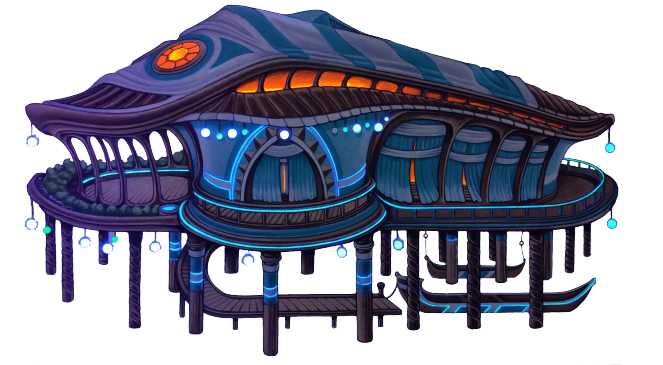
LAKEHOUSE HOME The Lakehouse is an example of non-tidal aquatic structures found in the Lakelands and the fens of southern Haun. They may experience periods of high rivers or even flooding but most are build with this in mind, with stout pilings that can be easily replaced, repaired, or adjusted with floatation risers. The structure is non-Euclidean to some degree, a creative arrangement of spars and beams covered by heavy cloth and waterproof adobe, and having no straight walls or corners of any kind. Their version of feng-shui is an open-concept that’s easy to escape from within. The lakehouse shown here is quite large and grandly-appointed, that of a chieftain surely. It was large enough to host a large family with room leftover to host another, host visitors, or hold social gatherings. The interior is lit with simple self-extinguishing palm-oil lamps, and may be warmed with braziers. External lights are most often glass or cystal lamps filled with battery dust that charges phosphorescence during the day. The cloth wall sections make it quite breezy, as it was made for people who already have an insulating coat of warm fur. Smaller lakehouses are more typical, and in large numbers they can be linked by simple bridges. Most have an under-dock with canoes or rafts which can be hoisted up on block and tackle when not in use. This dock also serves as a place from which one might catch fish, as fish are often attracted to the columns on which the structure sits. The door to this under-dock area is usually in the lakehouse common room, and can be closed and secured. Other features range widely, and may include a kitchen with an exterior deck for growing fruit, vegetables, and herbs, a room to smoke or dry fish, crafting areas for leatherworking or clay sculpture, nurseries, etc. They are the most common form of habitation in the Lakelands area, though they may be found in the tropical south where lakes, lagoons, or marshes allow non-tidal structures to exist safely. Details: The lakehouse is only one form of lutraic home structure, though it’s by far the most common. The idea is to create a home that’s easy to access or to escape if necessary, hence the profusion of cloth walls. Being out on the water, they’re naturally harder for predators or even insects to breach, and while aquatic dangers may still exist, very few of them can climb up the piers, which are regularly greased or oiled to protect the wood. Most of them are build near shore, but deep enough to allow for better fishing, and sensible lutrai put nets out to catch all sorts of things while they’re busy elsewhere. Maintenance is fairly simple, usually involving fresh clay, new hangings, or fresh tarp covers. They were designed to be easily rebuilt, and some are even able to detach from their pilings in order to float on their own in the event of a flood.
Mechanics: The lakehouse provides a comfortable shelter for resting, crafting, and even hiding out, as they’re full of movable cloth walls and contain a lot of clever concealed spaces. They aren’t terribly durable if subjected to attack or deliberate damage, but they’re also easy to build, fix up, or modify due to the light, common materials used in their construction. Treat these as a standard wooden house, though they may also be considered fire-resistant due to the easy access of water all around, and the well-saturated wood which wicks up a degree of the ambient moisture. Even the grease they use as a preservative is inflammable, and often laced with insect repellant additives.
|