






|
|
|
|
THE SHALLOWS The shallower stretches of ocean are full of brightly-coloured hydrogen-breathers like these. Such fish are adapted from the lost ocean world of Naiyos, which drifted out of Rym’s habitable zone long ago. The frozen seas yielded up their share of fossilized life for the Urn to play with, and it may have used some of these as base models for its construction of Rym’s ocean biomes. Or it may have simply wanted another garden of reincarnation, a haven for lost flora and fauna to supplement the more complicated ecosystem of the planet. Unlike Rym’s fish stock, these metabolize hydrogen as well as oxygen across their gills or membranes, allowing them to manifest different varieties or organic alchemy and even electrolysis. They can be found in the upper ocean, the Epipelagic zone between 0 and 200 meters. Most of them have a wide range of size based on maturity and the depth at which they dwell, with larger variants inevitably inhabiting the deeper areas of the sunlit region.
|
|
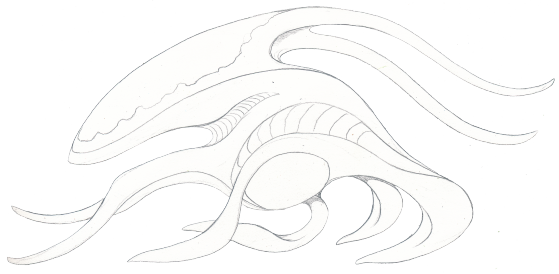
HEXAPAX FIFTH EDITON The hexapax is an unusually-intelligent gelatinous mollusc hybrid rescued from the frozen ocean world of Naiyos. The Urn recreated a smaller, less sophisticated version of it on Tropos, though it wasn’t a viable candidate to inhabit Rym’s colder saline waters. It now exists in a more delicate low-gravity environment, moving between the tidal pools of the ocean moon’s equatorial region. The hexapax inflates its body with metabolized hydrogen in order to lighten the load on its soft tissues and is able to liquify portions of itself to act as a sort of slime mold, covering its lair in a fine lattice of paralytic membrane. It can feed on simple marine snow or larger organisms which wander into its web, and even catch larger prey by way of an invisible intoxicant ink. Though the smaller specimens don’t pose any real danger to travellers, this species gets larger every time it reproduces and may eventually become sizeable enough to threaten swimmers or even people who fail to spot them crouched in Troposian tidal flats. They’re almost invisible when they want to be, and one must be cautious of any small body of water in which they dwell as it may already be laced with their numbing natural toxin. ENZYME NAPTIME This predator gets it name from its strangely-peaceful method of predation. It puts its victims into a peaceful slumber from which they never awaken. Any gilled or water-breathing prey are at a great disadvantage, as their aura of invisible venom passes directly into the bloodstream when inhaled. Creatures with thicker skin or held-breath aren’t in such danger. Once immobilized, the prey is gently pulled into the gelatinous abdominal cavity and dissolved – the hexapax has no mouth, and some believe that its digestive system is actually a symbiotic slime or jelly not unlike the gelatinous cube. Unsurprisingly, the creature prefers fellow marine life for sustenance and is intelligent enough to spare air-breathers from time to time. |
|
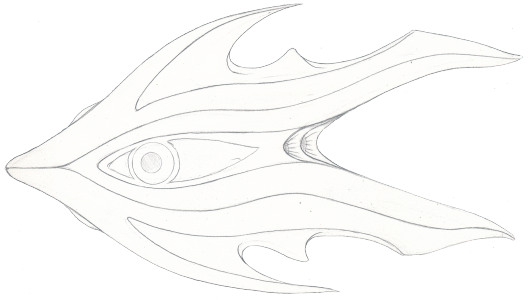
SAGGITUS FIFTH EDITON The basal form of the silver jetperch and other pulsatile fish of Rym’s oceans, the saggitus is another refugee from the lost ocean world of Naiyos. It has three eyes, one of which is large enough to transverse its center, the other two being simpler photo-sensitive orbs used for navigation. There are several species, which grow larger, faster, and more aggressive in deeper water, though they’re not particularly dangerous until they’re big enough to swallow you outright. The saggitus inhales water, drawing out its hydrogen through saline electrolysis and occasionally igniting it to create an explosive jet propulsion burst. This mild electrical ignition process is common to several of the hycean species, requiring a buildup of metabolized substances which can be depleted quite quickly under stress. The complex biological chemistry is only possible on Tropos, which has an abundance of these resources laced into its mineral-rich waters. The pulse-jet speed of the saggitus is both its method of escape and its method of hunting, as it employs one of the oldest and simplest methods of subduing marine prey – ramming. SMASH AND GRAB The saggitus’ hardened cranial cartilage allows it to punch out its prey on a charging attack, an explosive burst of speed which relies on inflicting concentrated trauma or even instant death. It instinctively attacks the head or eyes of its prey, and can split the harder skulls of other fish in half in a head-on collision. Smaller fish are simply inhaled and electrocuted within its inflatable body cavity – the copper dart being its favored prey. It may even seize unfamiliar creatures and jet-ram them into rocks or coral to kill them. Some species have even been known to punch holes in rafts from below if their territory is encroached upon. This can occur in waves, schools or 'volleys' as they're called; a repeated sequential attack by multiple saggitus groups can be even deadlier than a swarm of pirhanas or barracudas. |
|
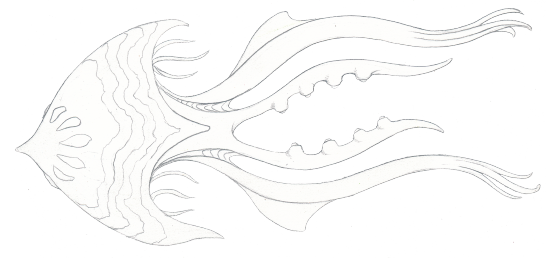
FULVEX FIFTH EDITON A cousin of the hexapax is the larger and more dangerous deep-water fulvex, a mesmerizing bioluminescent mollusk that disorients predator and prey alike arranging its upper mantle in different shapes, patterns, and colours. They range in size from an arm’s length (fulvex minoris) to the gigantic fulvex titanis, which is the size of a car, though their body plan and method of locomotion remain nearly identical. When submerged, they use their primary outer tendrils to propel themselves in an oar-like motion, though they tend to conserve energy while hunting, inflating their upper mantles with hydrogen and floating over the surface with their shorter tentacles electrolyzing seawater to maintain their supple of lift gas, and to stun-shock anything drawn to their lamp-like glow. Their mesmerizing chromatophores are reserved for subsurface prey, or to attract mates. They have no mouth, relying instead on a series of thin tendrils beneath their upper mantle to hold stunned prey against the digestive enzymes of its delicate inner lining until they dissolve. FLOATING SHOCK The translucent inner tendrils create a mild charge between them – anything which swims between the nodes completes the circuit. This shocking grasp stuns most smaller marine animals drawn to the glow of the floating upper mantle, which remains just above the water’s surface. In Tropos’ low gravity, this sort of buoyancy also allows them to escape marine predators for a short time, especially in high winds, as they can retract their tendrils and add extra inflation for a brief time in order to drift away unseen. Like many of the species adapted from Naiyos, they rely very heavily on electrolysis to create the hydrogen in their bodies and don’t do nearly as well in ordinary gravity environments such as planetary oceans. The slow undulating waves of Tropos are essential to their metabolism. |
|
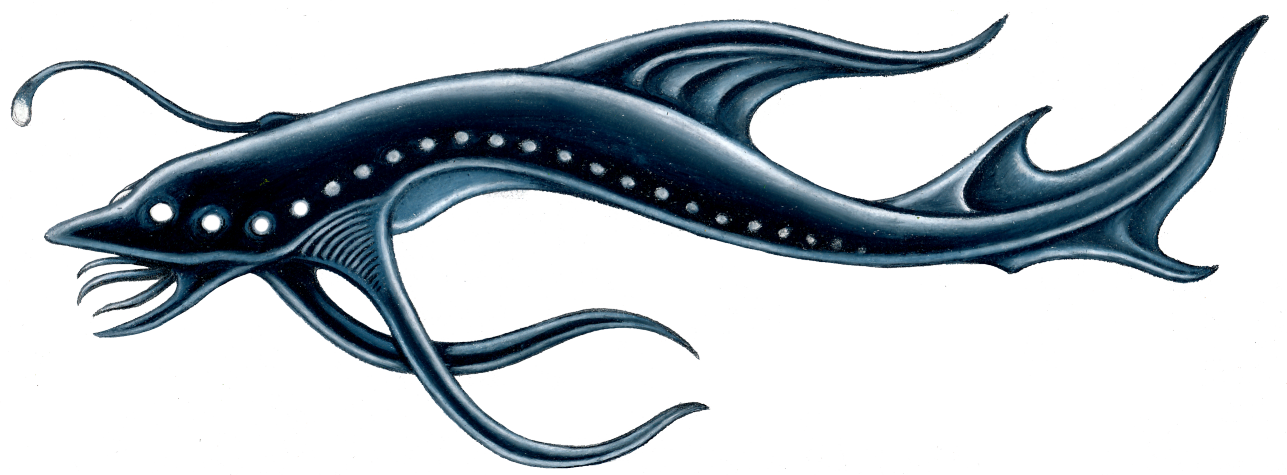
ANGUILLEX FIFTH EDITON A distant cousin or ancestor of the aboleth, the cave-dwelling anguillex is one of the more frightening constituents of the ocean moon’s deeper waters. This crafty terror uses a lamp-like lure to draw unsuspecting prey close enough to seize with its tentacular mouthparts – multiple tongues which invade gills, eyes, or other cranial orifices in order to deliver a lethal dose of venom. The larger specimens use simple crushing pressure to collapse the head, though in either case death is extraordinarily quick. The anguillex may also use its long, modified tentacle-fins to reach into crevices in order to flush out its prey, as it tends to hunt very close to the bottom where it can feel around in the sand for anything which may be buried in hiding. They have seven eyes adapted to the dark benthic zones of Tropos’ deeper trenches and though they don’t see very well, they’re able to perceive the bio-electrical aura of almost any living creature in their vicinity. Their own bioluminescence is unmistakeable, from the gently-pulsing lobe of their lure to the row of electric-blue stippling along their flanks – both become brighter when they see prey that interests them. BENTHIC WRAITH These are the assassins of the deep, moving in slow silence amidst the grottoes and crevices of underwater caves, and shunning the light of shallower waters. At night, they tend to emerge and hunt the upper waters they avoid during the day, luring creatures down close enough to snag and drag back into their lairs. Though they rarely grow larger than a moray eel, there are larger specimens in the twilight zone which have been known to attack full-size humanoids.
|
|
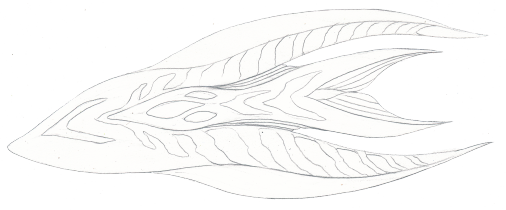
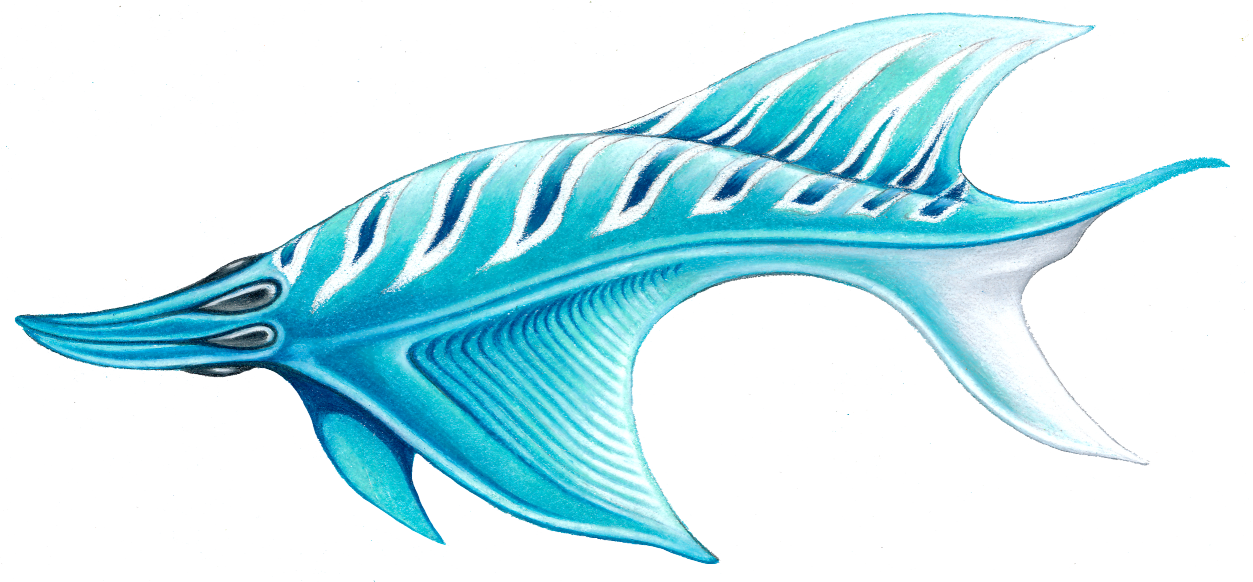
FURTIMALI FIFTH EDITON Tropos’ low gravity allows certain fish like the furtimali to fly for considerable distances, spreading modified fins to glide over the slow-rolling waves of the ocean moon. When it spots prey in the water below, it will drop its symbiotic mate like a bomb. The smaller projectile has its own flight-fins, though these are used more for angling its descent, allowing it to spear its sharp head spike directly into the inflated mantle of its favorite food – the fulvex. The two halves of this mated pair may operate independently, but once mated they become fully dependent on each other and operate far more effectively, both in flight and on the hunt. Separate, they school up with members of their own sex for protection and only grow to full size when sharing their biology, particularly their digestive system and flight canards. The larger female has only a rudimentary photosensitive occular strip, and is steered to some extent by the three-eyed male by the sharing of certain nerves while connected. These contact points become apparent when the two are separated. STEALTH BOMBER Some suspect that this closed-circuit couple was far more advanced at one point, possibly in its early ancestry on Naiyos, and that it has since devolved into the specialized form that now preys almost exclusively on balloon-bladder fauna. The Urn may have simplified it during reconstitution, allowing it a better chance for survival in the smaller, more closely-knit ecosystem of Tropos, or it may simply have regressed on its own, trading higher sentience for greater efficiency. Whatever the case, there may be occasions when it mistakes a colourful hat, helmet, or hairstyle for the upper mantle of its favorite prey, prompting it to bomb beachgoers or unsuspecting boaters. This may be avoided with special reflective or deflective headgear.
|
|
VELOCANTH FIFTH EDITON Another flying fish, the velocanth is pointedly larger and more aggressive than most of the wing-finned species found gliding over Tropos pan-oceanic surface. This one rides the strong winds of the ocean moon’s frequent storms, a living cruise missile with a deadly diving tactic. Its mouthparts spread into a ring of blades as it plunges down into schools of immature furtimali, usually females, attempting to slice through several at once. The star-shaped arrangement of its head matches the ring of seven eyes, letting it see in all directions as it maneuvers, and even in the water it can hunt like a radial swordfish, punching through groups of smaller and then closing like scissors to cut them apart. This unusual jaw is spring-loaded, held shut by a cartilaginous clasp and released by a reflex to snap open with enough force to shear through flesh, fins, and even skeletal structure – the blades are lined with toothy serrations. Mostly relies on diving speed, however, as its manta-like movement in the water isn’t nearly as effective for hunting. SLICES AND DICES The velocanth is technically a swordfish, though ‘flying blender’ would be more accurate. During a dive, it can angle its wings to create a spinning motion, a shredding corkscrew that can kill even large creatures under the right circumstances. This occurs near the surface, and so staying on land or in deep water is a reliable way of avoiding deadly encounters. Some of these are dolphin-sized and literally require a storm to fly effectively, making them a serious danger in the high waves of any Troposian tempest. They will ride these waves and literally burst out into high-speed flight when the creature is ready to attack – they duel each other in the air like samurai during the mating season. |