





|
|
|
|
Rym is sparsely-populated. The Automatic War left the world in ruins for hundreds of years, and the descendants of its few survivors are shown below. They fall into three broad categories, the natural, the artificial, and the mechanical. Others may exist, of course, those who have fallen through ton storms from other worlds, though such alien curiosities have no significant population base outside of the Decider's menageries.
Newkind: These are thought to be the reconstituted remnants of six extinct humanoid civilizations, also called 'The First People'. They were the first inhabitants of Rym, brought from dead worlds by the Urn and introduced into its world-spanning sanctuary during the First Age. Only four of these remain to this day – the kuil (Rym’s humankind), the gorgs, the koba, and the c’zath. They are predominant, controlling most of the territory and shaping its political landscape. These species all bear the so-called ‘hyphael’, an essence or soul which linked them to the gods of a bygone era. This is an identifiable cerebral structure which set them apart from non-sentients. In essence, the hyphael is the black box of their lifelong experience, a record that could be read and judged by Rym's deities. As such, they were beholden to all forms of divine influence and coercion, and capable of channeling it in different ways. Nilkind: These are the mutant beings made by the kuil during the Second Age. In an act of rebellion against their divine wardens, the people of that era uplifted various animals to serve them as they had served the gods. These animals were made sentient without a hyphael, and were thus free of divine influence, whether fear, awe, or temptation. They were ‘nokind’, or ‘nilkind’, soulless adjuncts to the conquest of the Creator State. The kuil used them to expand their dominion in unnatural ways, and to engage the fantastical remants of the First Age in open conflict. Several species of nilkind remain to this day, having earned the right of reproduction from their creators. They exist in 'duons', paired sub-species made for alternate purposes. The most common are the skoles, the cepn, the lutrai, and the ixis. They have no afterlife, though their offspring inherit an unusual degree of similiarity and aptitude from both parents in the hazy suggestion of reincarnation.
Machines: Though they may look like robots, the Machines are Rym's undead caste. They come in all shapes and sizes, counting any mechanical body that's been fused with a living kuil. During the Second Age, the kuil used this crude form of immortality to cheat death, though most who underwent the risky TI procedure ended up becoming zombies of a sort, only fit for simple labor or mechanical control. Other TIs were more successful, though only the most exotic, expensive procedures were able to preserve any degree of sentience and sanity. Most Machines are simple automation - doors, lifts, facility announcers, and so forth. Those with humanoid bodies and wills of their own are the ones shown here, Rym's 'intelligent undead'. They keep to themselves, inhabiting many of the ancient nicrete ruins of the old Creator State. Only in such places are they able to find the parts required to keep their old bodies running smoothly, either by salvage or cannibalism.
|
|
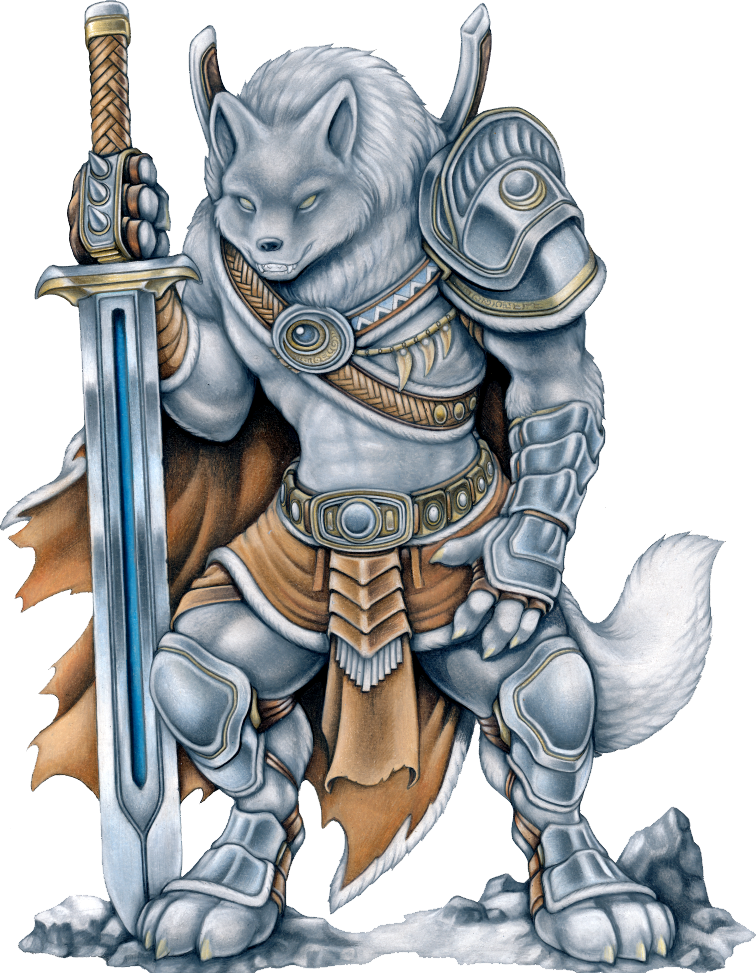
NORTHERN SKOLE D&D FIFTH EDITION The Antithetical Gnoll: Contrary to popular belief, northern skoles were originally bred from domestic war dogs, and only developed their lupine features after several centuries in the wilderness. Before that they were closer to huskies or malamutes, though the uplifting process was tweaked to make them look and sound fiercer than the original canine stock. They are more than happy to lean into this wilder aspect and will howl, snarl, and act wolf-like any time they want to reinforce it, though most of them still have some carefully-hidden domestic instincts, especially around their former handlers. Dogs of War: Uplifted from military dogs crossed with wolves, and jackals, skoles were unnaturally well-suited to army life and regimented service. Their natural pack instincts were easily adapted to squad tactics and rank structure, and having been bred for loyalty, obeying their kuil handlers was practically intrinsic. The Creator State rewarded this behavior rather than simply expecting it or exploiting it, however, though it could be said that their prior appreciation of canine pets had more to do with this than any ethical consideration. In return, the skoles fought and died with a fierce and uncompromising faithfulness that not only unnerved their enemies but also made mockery of the old gods and their more elaborate, ecclesiastical system of worship and obedience. To the kuil, they were natural bodyguards and didn’t hesitate to sacrifice their lives in the service of those who raised them. Northern Face: Skoles of the north theater were the larger breed, and more suited to the rugged wildness than their southern counterparts. Northern skoles are built for the wild and not quite as comfortable within the confines of a city. Aside from their larger size and menacing presence, they tend to prefer an open view of the sky and the horizon, the presence of game, and the feel of natural terrain. While southern breeds were built for urban environments, these natural rangers and hunters were more effective in open environments such as forests, mountains, and plains. They’re so rugged they can get a full rest without even needing a tent or bedding, and have little want for winter clothing in even the harshest climate. They don’t even need to cook their food, and will more readily eat their opponents in a pinch, much like gnolls or ogres - they're notoriously un-picky eaters. Northern skoles take pride in their survival skills and work together as a unit more naturally than as individuals. In fact lone skoles of this variety tend to be anxious if they don’t have at least some sort of a pack or rank structure around them. This compels them to treat virtually any group as their pack, and while they don’t necessarily consider themselves the alpha, they will instinctively act the part in the absence of strong leadership. Good Boys: Though not quite as reverent of the kuil as the southern breed, northern skoles are extraordinarily well-mannered and well-behaved around Rym’s humankind. This is a natural instinct that’s almost impossible for them to shake, and though some are able to hold a wagging tail or lolling tongue, their friendly body language around those who raised them from common beasts is hard to miss. This doesn’t make them subservient, but it does give them the natural urge to win the approval of any kuil they come across. It’s very difficult for them to refuse a kuil’s request, and those who must have developed a series of psychological tactics in order to do so without anxiety. Ability Score Increase: Your Strength score increases by 2. Age: A skole reaches adulthood at the age of 16 and generally lives to be 70-80 years old, though most die in battle long before this. Alignment: Most northern skoles are lawful or neutral good, having preserved their ancient battle conditioning over the last seven centuries. They really are the antithesis of the gnoll - brave, compassionate, fiecely-loyal, and honourable to the bone. They were made to be, which some see as artificial, though no moreso than the unnatural fiendishness of the gnollish breed. Size: Skoles are massive, usually 7-8 feet tall and built like werewolves, with an enormously-powerful upper body. They weigh 300-400 lbs. on average. Their size is Medium. Speed: Your walking speed is 30 feet. Darkvision You can see in dim light within 30 feet as if it were bright light, and in 30 feet of darkness as if it were dim light. Rugged: You have proficiency in Survival and Constitution saving throws. You have Resistance to cold damage.
Hungry Like the Wolf: You can use your bite to make unarmed strikes. Your bite inflicts 1d6 + your strength modifier as piercing damage.
|
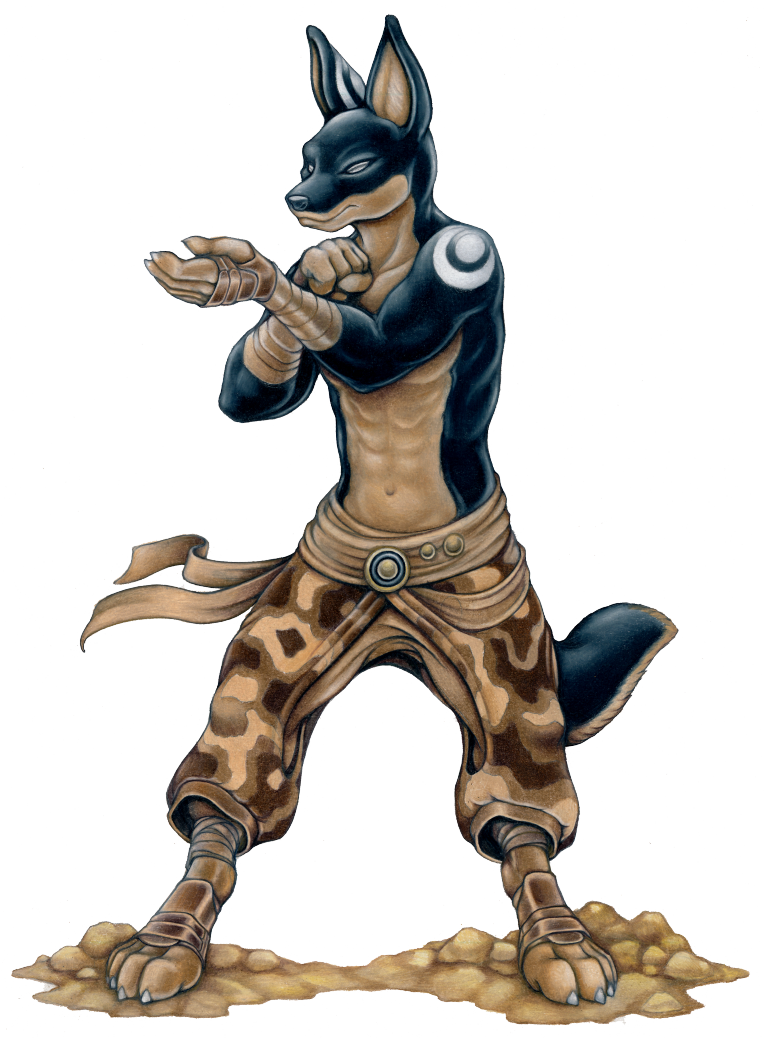 |
SOUTHERN SKOLE The Canine Unit: While northern skoles mostly served the army, the southern line served as law-enforcement within the Creator State. They were an extension of the police force, brought in as backup for any situation that would require tracking, breaching, or hot pursuit. Faster and stronger than their kuil creators, they were developed before the northern line and more closely tied to the structure of kuil society. Their obedience was forced upon them by the Guide language, a conditioning that haunts them to this day. The Decider herself controls significant numbers of them in the West, where her morning broadcast is heard. Those who seek to escape her influence must flee the coast or find some way of blocking out the clarion towers which broadcast her ranting diatribes. Their northern cousins were able to escape into the wilderness in order to do so, though the conquest of the West subjugated most of the southern line, who could not. Downtown Hound: Southern skoles were heavily woven into the old Creator State’s police force, though crime was never as serious then as it became later. Like the northern bloodline, they worked very well in an ordered, lawful structure of governance and lifestyle, their instincts more naturally-attuned to the Guide language and thus the obedience kuil commands. They patrolled the streets at night, secured buildings and facilities, and tracked down ne’er-do-wells. Most of them carried non-lethal weapons and used vehicles to get around, had their own specialized apartments and enjoyed the benefits of urban civilian life, and to this day these preferences remain, bound up in their nature by Diamond Life’s transformative conditioning. They also have an innate fondness for vehicles of all kinds, especially fast ground models, and display phenomenal driving instincts when it comes to vehicular pursuit, or just pursuit in general. Southern Comfort: Skoles of the south theater were smaller, sleeker, and more accustomed to urban living. They were the security forces of Diamond Life’s domestic offering, though later military service would blur the lines with those of their northern cousins. They were more comfortable in the southern climates of their ancestral stock, and more at home in Axis than anywhere else. Some say this made them softer than the northern breed, though what they lacked in stature and wilderness acclimation was easily compensated in urban savvy and street combat, especially when it came to fighting crime. Even to this day, southern skoles are more dog than wolf or jackal, though they’re even more adept at managing and presenting their more intimidating traits. They have a more complex social hierarchy which, while including rank, also measured a wider variety of social connections and aptitude scores. They can survive just fine in the wild, but they prefer the comforts of civilization. They're found predominantly in Haun, Erdanis, and Caefax, though a significant number of them fled East with the remnants of the old protectorate after the Decider’s conquest of Western seaboard. Those who remained are largely under her control, and heavily influenced by her morning broadcasts on Channel D. Her voice alters their perception of the whole situation, causing most of them to think of her conquest as righteous, or at least a good idea. They find it virtually impossible to defy the Guide language due to repeated exposure over Channel D, and salute in unsettling unison at the end. Best Boys: Southern skoles have a more developed Guide module in their brains, and so their natural instinct to obey kuil is more formal and less shamefully acknowledged. While some are less willing than others, they find it very difficult to oppose or fight the kuil. Even when forced, they have well-developed non-lethal takedowns and will always try to spare their lives unless they have no other choice. Some kuil take advantage of this, though only as long as the Decider doesn’t hear about it, since she considers every last one of them to be her servants. She reinforces this over the radio every morning, her voice heard across clarion towers throughout the Tamaran Triad. She calls them ‘her boys’, though at least half of them are female. Ability Score Increase: Your Strength score increases by 2. Age: A skole reaches adulthood at the age of 16 and generally lives to be 70-80 years old, though most die in battle long before this. Alignment: Southern skoles are lawful by nature and must escape the Triad in order to comfortably adopt any other sort of alignment. They tend to be a bit more chaotic outside of the ‘Leash Lands’, as they call them, and dread hearing the Decider’s voice as it still has the power to move them against their will. Size: Southern skoles are big, usually 6-7 feet tall and tend towards lean, muscular builds with more powerful lower bodies. They weigh 200-300 lbs. on average. Their size is Medium. Speed: Your walking speed is 35 feet. Darkvision You can see in dim light within 30 feet as if it were bright light, and in 30 feet of darkness as if it were dim light. Loyal Vigilance: You have proficiency in Perception and Investigation due to your excellent sense of smell. You have advantage on all saves against Charm, Command, and Dominate effects.
Chew: You can use your bite to make unarmed strikes. Your bite inflicts 1d6 + your strength modifier as piercing damage.
|
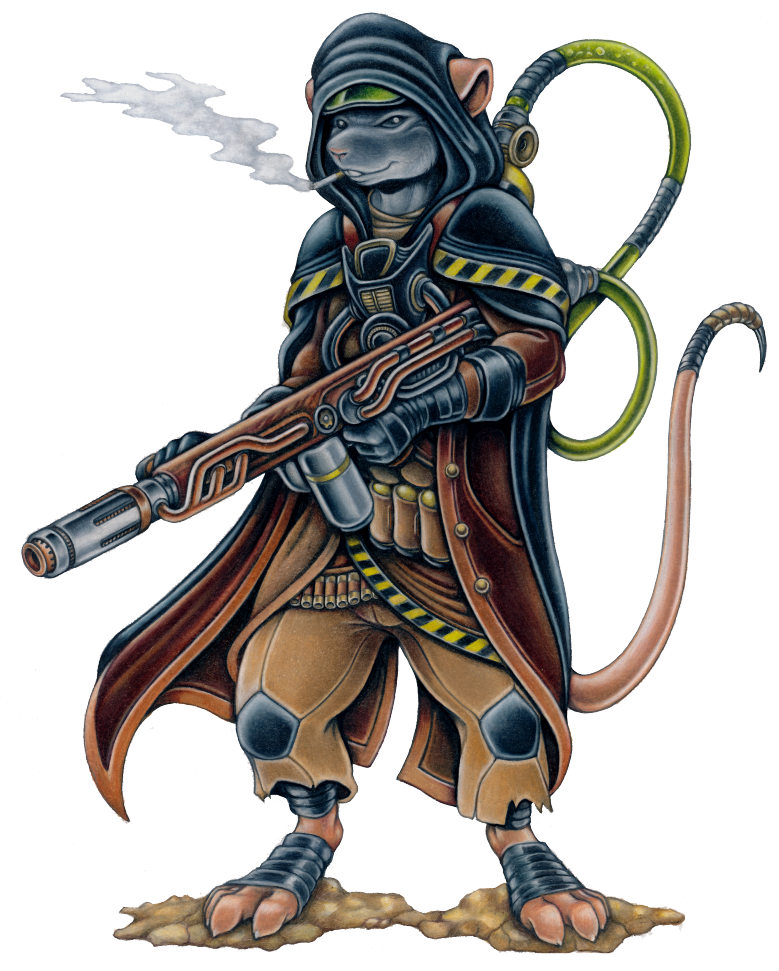 |
GREY IXIS The Lab Rat: First to be uplifted, the Ixis were Diamond Life’s earliest attempt to master the life-code alteration of the fallen Kobath Empire. This alchemical evolution had been used for thousands of years to selectively enhance royal bloodlines, and stripped of all its sacred religious overtones, it was an even more powerful tool for altering mammalian forms. Rats had no hyphael, no link to the old gods, and could be bred in massive numbers to accelerate the process of trial and error. For years they were kept in tiny form, intelligent but powerless to resist those who made them. They predate the Guide module, though they were used in its development for later lapine experiments. Ixis were kept as test subjects even into the last days of the Creator State, and rebelled as it came apart, overwhelming the island laboratories of Vindova and taking full control of the island chain within a matter of weeks. First on Two: Diamond Life’s first great triumph was the humanoid stance. They got rats to stand and walk, first for brief periods and then more naturally in imitation of those who made them. This was a massive leap forward for the titan of life and its board of directors, who immediately set to work on more advanced features such as the opposable thumb and the attitude. The ixis were the baseline for all these traits and take a certain twisted pride in this now, centuries later, having paid so high a price in generations of experimentation. Having taken over the facilities which created them, the ixis are now able to guide their own artificial evolution, creating titans of their own such as the ‘grey’ which stand nearly four feet high. These are their ambassadors to the world, as it were, able to negotiate with others beyond their borders or at least imply a greater threat to be taken more seriously. The rest are tiny little maniacs. Goblin Mode: Ixis are the goblins of this world, you might say, being of much the same size and attitude in their native setting. Outside of Vindova, they’re more adaptive and open-minded, but Vindovan society still has a lot of resentment towards the old world and its constituents. They’re thinking of taking over, and while the average ixis traveler doesn’t know their big plan, they may be unwittingly playing a part in it. The titanic grey ixis are often given an assignment of some kind, an objective that gives them some reason, however obscure, to return to Vindova at some point to learn what it was. All ixis have some kind of sub-objective, often unbeknownst to them but knownst to the storyteller. This might involve meeting someone, getting something, or causing some sort of catastrophe. This purpose is subliminally-programmed and independent of the ixis’ alignment or other goals, and may be used by the storyteller at a dramatic moment or as a plot twist that nobody sees coming. This can be for good or ill, and creates a sort of built-in tension and anxiety that helps to define their ratty personality. Bad Rap: Of course, some people have gotten wind of what the Vindovans are planning and they’re wary of any ixis’ loyalty. They may not know exactly what they’re planning, but they know it’s probably bad, or at least embarrassing, and may naturally express their suspicions any time one shows up. This only helps to reinforce mistrust in both directions, and while some ixis embrace their bad reputation, others seek to purge or serve out their purpose so that they can get on with life outside of Vindovan influence. They oppose the Decider and her conquest, but aren’t willing to ally with any other nation against her. They think they’ve got it handled, and won’t rely on anyone else, short of some sort of miraculous event or terrible calamity. Ability Score Increase: Your Dexterity score increases by 2. Age: Grey ixis live significantly longer than their tiny brown counterparts, reaching maturity by 14 and living to be 60-70 years old on average. Alignment: Most ixis are at least a little chaotic – they never got the Guide module and the frantic nature of their adaptive thinking lends itself to a much looser code of conduct. This doesn’t make them immoral, but it does give them a very wide variety of amorality that must be adapted to anywhere they go. For this reason, they’re often seen as mercurial, though they do develop very strong friendships which transcend this moral flexibility. Size: Ixis are pretty small, usually 3-4 feet tall and built long. They weigh 30-40 lbs. on average. Their size is Small. Speed: Your walking speed is 30 feet. Your burrowing speed is 5 feet. Darkvision You can see in dim light within 60 feet as if it were bright light, and in 60 feet of darkness as if it were dim light. Flexible: Ixis can squeeze and move at full speed, and move at full speed when prone. Standing up from prone takes only 5 movement.
Sneaky: Ixis are proficient in Stealth and have proficiency in Dexterity saving throws.
|
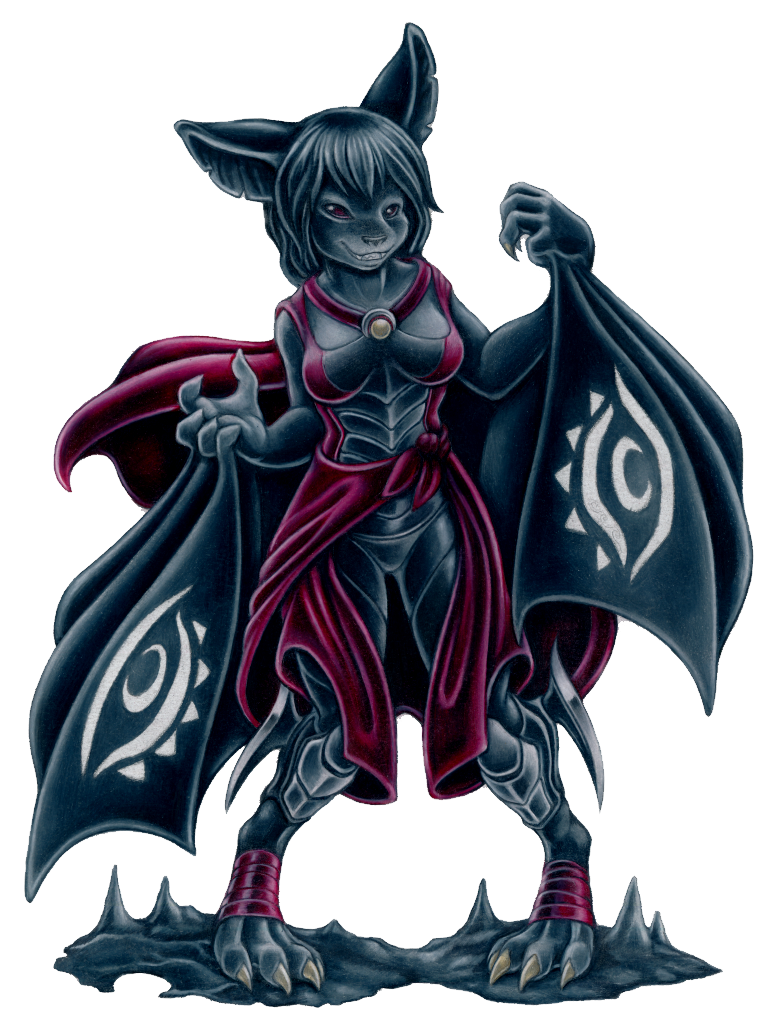 |
NIZRIL CEPN Voice of the Dark: While most subterranean races see well in the dark, the cepn were born to it, and see with more than their eyes. Their ultrasonic whistles map every crack and crevice around them, and well beyond line of sight. They were selected to take on the dark corners of the world and all the horrors of the deep, and did so with the murderous focus of militarized vampires. These were the nizril, those who weren’t made for the open sky. While their fruit-eating cousins were transformed into pilots, these cepn were deployed to Rym’s cavernous underworld and given all the tools needed to exterminate its fearsome inhabitants. Their purpose was more specific to their environment than most of nilkind, and so they’re not nearly as comfortable on the surface as the others. Last Out: The cepn were the last line of nilkind, and the most difficult to create. The Creator State wanted flying terrors, and got close enough with gliding assassins for Diamond Life and Aktek Militar to release them in vast ‘cauldrons’. These were megalithic nicrete structures which plunged into the dark underworld like invasive ships on a lightless shore, spewing forth swarms of deadly citropten killers to prevent any deep denizens from escaping the Bore Flood. The nizril were kept secret like all of the militarized nilkind, but these took cloak and dagger to the literal extreme, and were a horrifying shock to those who had considered themselves the epitome of darkness. Grim, silent, and secretive, the cepn were so made as to fear nothing in the dark, and to grow stronger in its presence. Also, they’re really big on poetry and ultrasonic instruments, and rarely have need of the surface or its inhabitants. Born to Kill: While not all of them act like vampires, their instincts were tuned to lethality and a natural aggression towards anything scary. Fear-using or horror-reliant entities will find themselves swarmed and attacked first, mostly to make an example for the rest. Their murderous impulses are controlled by the Guide module, and can be shut off with the correct combination of sounds, causing them to leave as quickly as they arrive. They were made specifically to destroy denizens of the deep, and the Order of the Moth remains in place to guard against anything which might still crawl from its shadows. Most of them fit this role like a glove, though some have taken a dimmer view of their darkness and left the deep places to find a higher purpose despite all of their natural aversions and the fear of those they meet. It scares them more than the dark ever could, and breaking the terrible hold of their nature has transformed some of them into wise doctors, cunning craftsmen, or righteous equalizers. Bloody Good: Like vampires, the kizril sustain themselves on blood. They can live on meat and other proteins but this gives them a sickened condition until they can get the real thing. This means they need to bleed other creatures or even each other from time to time, at least to supplement their diet, and an entire cultural hierarchy has evolved around this practice. They have surface-connected hospitals dedicated to acquiring blood in lieu of the more traditional surface raid or biting in the dark, and will even pay others for their blood rather than simply murdering them for it. This was a function of their early conditioning and an artificial blood ration provided by the Creator State. Their Guide module gives them a ‘blood rush’ when they drink it, briefly boosting their speed and prowess and making them quite giddy and unusually agreeable for some time afterwards. They really can be happy and content, it just involves the right cues. This leads them to a blood-bond with non-cepn on some occasions, and this seems to accelerate their decoupling from the murderous impulses of their past. Ability Score Increase: Your Dexterity score increases by 2. Age: Cepn reach maturity by age 16 and live to be around 60-80 years old, much like the kuil who made them. Alignment: Most cepn have dark urges and tendencies incompatible with good alignment, making those who strive to escape their nature all the more striking. They tend towards neutrality, focusing on their own lives more than any particular cause. They aren’t inherently evil, though the Creator State leaned them that way. Size: Nizril are smaller and lighter than the fruit-eaters, usually 5-6 feet tall and quite slender. Their size is Medium. Speed: Your walking speed is 30 feet. Your climbing speed is 20 feet. Your gliding speed is 60 feet with each 10 foot drop in available altitude. Darkvision You can see perfectly in the darkness and you're Dazzled in normal light. Cover is ineffective against your ranged attacks as long as you can whistle. Killer Instinct: You have automatic proficiency in Stealth. If you gain proficiency in Stealth, you have Expertise in Stealth. You are immune to fear effects of all kinds.
Sanguine Aptitude: Your critical hits with slashing and piercing weapons inflict 1d4 bleed damage.
|
 |
SOUTHERN LUTRAI In the Navy: Lutrai were the naval proxy, created to better-fit the role of sailors and divers. The kuil had a very poor aquatic aptitude and needed constant coast-guarding or life-guarding due to their innate fear of drowning. The old gods had taken advantage of this in countless ways and with a wide variety of mer-species, and when the Creator State finally took action, it was with otters. The common lutric, as it was called, became the basal form of both the Mariner and Littoral lines called ‘lutrai’. These playful, energetic, social creatures were uplifted into even more playful, energetic, social humanoids, and while they didn’t appear as intimidating as the skoles or as dangerous as the cepn, they were exceptionally effective in their designated roles. Like skoles and cepn, they work very well in groups and coordinate effort in unsettling degrees of unison, especially when dancing. Their Guide module is more advanced, and even in the modern era, many of them retain a measure of the old brain structures which connected positive cooperation to dopamine. This is just a part of their nature now. All Wet: Though they don’t actually live in the water, they spend so much time with it that it never bothers them. They’re naturally waterproof as it is, but also have no fear of the deep, raging rivers, or even floods. They enjoy fish, of course, so much so that nothing even remotely resembling seafood can intimidate them. They can swim vast distances as if walking, and even sleep on the water with a few minor accessories. Lutrai can hold their breath for several minutes at a time, see perfectly underwater, and swim faster than they can run. In groups, they’re able to rip open ships from beneath the surface, and even the most monstrous of sea creatures have learned to fear their death by a thousand cuts. Though cheerful and peaceful in most circumstances, they still have the energy of crazed weasels when facing down their aquatic adversaries, and have adapted a wide variety of tools and weapons which work perfectly underwater. Natural Lifeguard: The littoral species were Diamond Life’s first creation, made to guard swimming pools and waterparks, and after saving countless lives they helped to endear the entire concept of nilkind to a population that had grown wary of the larger, fiercer skoles employed by the military and law enforcement. They weren’t taken nearly as seriously, of course, being otters, and their popularity might have simple coincided with the waterpark craze of the late Bygone, and with the rise of aggression in various mer-species whose territories were being flagrantly crossed by vessels of the Creator State. This put them in harm’s way more frequently, and so the Mariner species was developed to fight in the Automatic War, along with a variety of new naval weaponry and specialized submarines. To this day, lutrai are natural lifeguards and will race to save people from drowning, even at great personal risk. It’s built into them, and transcends species or even innate animosity. They just don’t want people to drown. They’re also naturally proficient with the towel as a whip-like weapon and have an entire martial-art dedicated to towel-combat. Otter-Brained: Though they may be aggressive in aquatic combat, lutrai are naturally quite carefree and playful, friendly, and easy to get along with. They have a reciprocal bonding instinct and very strong social tendencies which are often mistaken for naïve or even foolish, letting their guard down just to feel the same in others. This is easily abused, and so they look out for each other more readily, and struggle to hide how they really feel about any situation. Their hyperactivity is also reciprocal, and when four or more of them get together they experience a sort of group psychology called ‘romping’. This was meant to serve military coordination but rarely connected to aggression, only the desire to have fun. Willing participants in a romp can use 'Command' on each other, with a Wisdom save equal to their Charisma score. Ability Score Increase: Your Charisma score increases by 2. Age: A lutrai reaches maturity by the age of 16 and typically live as long as a kuil, between 70-90 years on average. Alignment: Most lutrai have some degree of chaos in their thinking, with less emphasis on order and repetition. They’re creative and eager to express themselves, and so they prefer an open mind and a bendable schedule. They detest cruelty and oppression on an instinctive level, being free-spirited creatures even before their uplifting. Size: Lutrai are slightly smaller and sleeker than Rym's humankind, usually weighing between 150-200 pounds due to their heavy tails and dense coats. Their size is Medium. Speed: Your walking speed is 30 feet. Your swimming speed is 40 feet. Darkvision You can see in dim light within 30 feet as if it were bright light, and in 30 feet of darkness as if it were dim light. You can also see perfectly underwater. Divers: You do not suffer from decompression sickness and can hold your breath for 1 minute per point of Constitution. You have Resistance to any damage caused by water (a water elemental's slam, for instance, but not an Ice Storm).
Slippery: You have advantage on Athletics or Acrobatics checks made to escape a grapple or grab attack. You can don and doff armour in half the usual time.
|
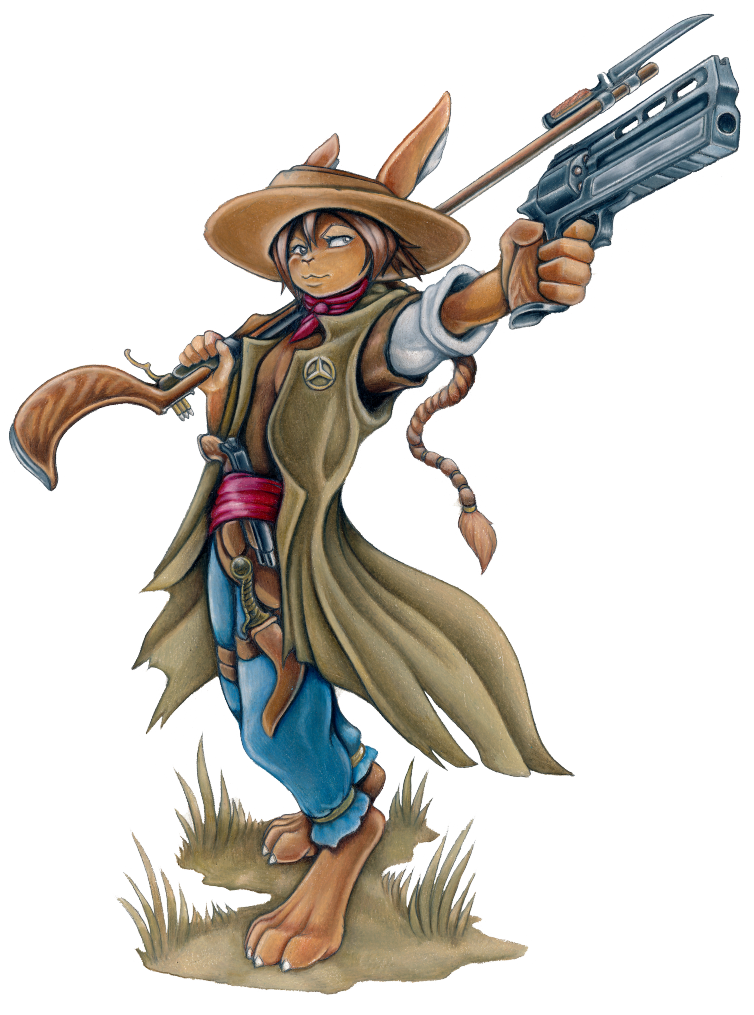 |
BASE NIL Warren-Coded: Nil were never made to be integrated into kuil society. Like the ixis, they were experimental animals used to develop the uplifting process, and the first to receive the False Hyphael. This was the Creator State’s imitation of the True Hyphael, a brain structure meant to guide the evolution of their sentience, and later to govern their thoughts. To these ends, they were warren-coded, a sort of geo-fence which kept them from leaving the maze-warrens of their initial testing facilities. The kuil were afraid of their own creation and left much of it to Aethos – they could never have created the False Hyphael on their own. The renegade demigod knew exactly how to hide them from himself, and thus his divine brethren, sequestering the rabbit folk in deep nicrete structures made in the likeness of warrens. Each of these had a cloned branch of his own mind to govern them, an educator made in his likeness, but without his name. These Wardens completed their transformation from animals into humanoids. Bound to Run: The experiments, though successful, left all of nilkind with the spark of a soul that could not be controlled. The Guide language was effective only within the Warrens, as if some part of their new essence was infused with the instinct to escape captivity and see the world. The Wardens were necessary to restrict this impulse and yet enough nil escaped to start populations elsewhere. These are Runners, those who defeat the warren maze and the isolated islands on which they were built, and by virtue of this extraordinary feat they earned their place in the wider world, beyond the mere experimentation which created them. This happened long after the war, and hundreds of years of failed attempts, proving that despite their small size and stature, the nil spirit could never be contained. No One Will Ever Know: Aethos meant to keep nils a secret, even after the war. They were the bearers of his greatest achievement, the False Hyphael, and he knew that while other inventions and marvels of his design could be filtered through the titans of the Creator State, the original design of the False Hyphael could not. For the other demigods to discover this monstrous act of rebellion would have been his ultimate undoing, and so even now, centuries later, Aethos fears that this early model of his interference might be discovered by Kij, or worse, the greater gods of the golden moon. For this reason, he has a special place for their lost engrams, and collects the souls of dead nils in a special artificial afterlife once reserved for the kuil. This is Animoi, a two-dimensional plane on which their past lives are looped in idyllic cycles and memories he can watch from afar. Animoi is a part of Aethos himself, a record within his own vast mental realm, and only accessible by his grace. Nils know about Animoi, and are the only form of nilkind that can be resurrected from death. In fact, it’s widely believed that many have already lived past lives, and that their memories are simply blurred away when they’re born again. This isn’t that far from the truth. A Thousand Enemies: EL-type Machines, or Sub-Wardens, were created to recover any nil that escapes their warren. While this was once a foolproof network of guards and protectors, the coverage has faded over time. Nonetheless, many nils have to watch out for a pursuer of some kind, one of the thousand predator-shaped EL Machines sent to retrieve them ‘for their own good’. These pursuers aren’t made to kill them, though they may do so accidentally, and will readily fight anyone or anything that gets in their way. This gives most free nils the constant alertness required to evade potential capture, and has given them a sixth-sense for danger and ambush that rivals a certain spider’s sense. They are always ready to get away. Ability Score Increase: Your Dexterity score increases by 2. Age: Nil reach adulthood by age 14 and live to be between 60-70 years old on average. Alignment: Most nils are lawful or neutral good, which is their default state. They were designed to be law-abiding and cooperative, though some have been known to rebel in chaotic ways in order to escape their conditioning. Even the really wicked ones seem to have a softer side, not just for their own sake but for their fledgling belief in the spark of soul they’ve been given. Size: Nils are small, but not so small as to be Small-sized. They're between 4-5 feet tall, with a lean upper body and wider base, usually no more than 100 lbs. Their size is Medium. Speed: Your walking speed is 40 feet. You can jump double your Strength score. Darkvision You can see in dim light within 30 feet as if it were bright light, and in 30 feet of darkness as if it were dim light. Jink: If you Dash, your AC increases by 2 until your next round.
They Must Catch You: Grab attack does not work on you, only grapple. You were made to evade capture.
|
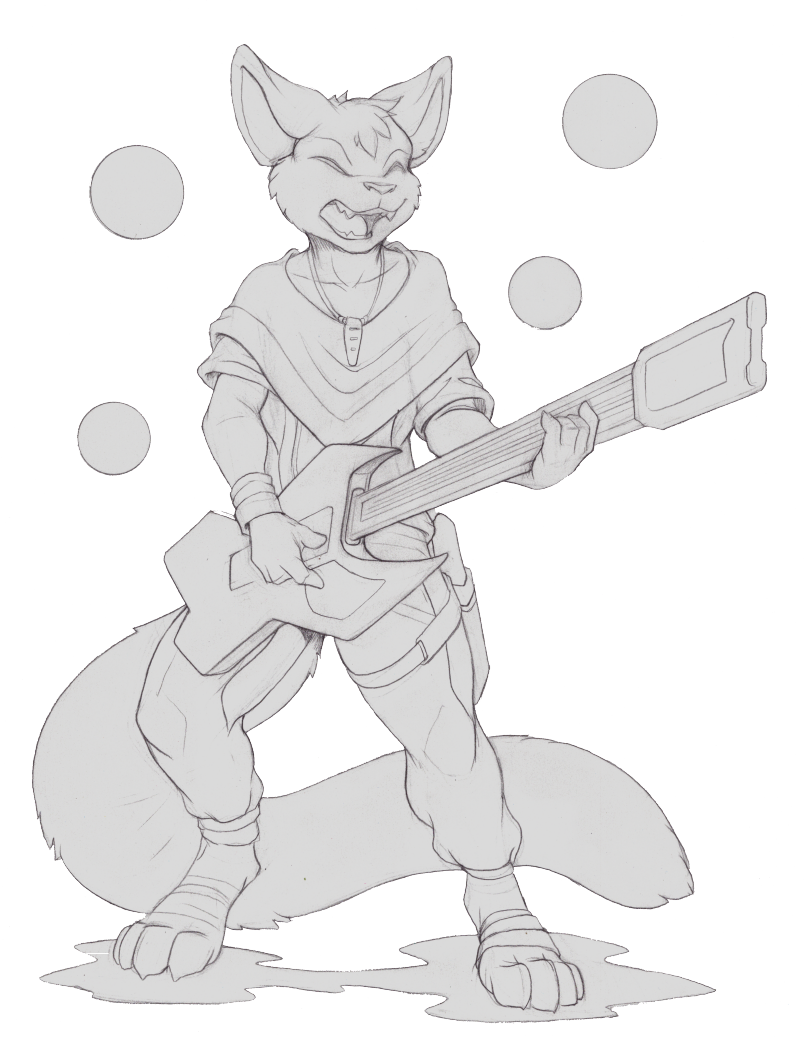 |
HOOMIKU ...But it's Aliens: The hoomiku are from the neighboring star system, Haizat, about a quarter light-year away. Their world, like Rym, was another of the Urn’s habitat exhibits, and they defied their own caretaker gods in an effort to make contact. When this failed, they began to suspect an unnatural interference and built a secret probe ship to visit their distant neighbors directly. The effort was doomed from the start, and many hoomiku now believe that it was collaboration between their respective caretakers which sealed their fate. Their people had been forbidden to leave their home planet, after all, and in doing so they invited a retribution which silenced all contact from both worlds. The probe ship and its four hundred sleeping colonists were left to drift through the darkness between star systems for nearly two hundred years, utterly silent for fear of being discovered and destroyed. They only woke up again once they’d entered the Kijian system, and found the world they’d been watching in ruins. When they attempted to land, their probe ship was detected by Nigh and shot down, crash-landing in the desert of Axis. This was nearly four hundred years ago. Observation Protocols: The original mission was to make contact and share knowledge, and also to discover the nature of their respective habitats and divinely-empowered wardens. They’re still on that mission, despite the ruinous state of the world they’d come to visit, and so their ambassadorial stance hasn’t changed aside from its disappointment in the sorry state of their neighbors. Most still live around their crashed ship, attempting to repair it while their diplomats venture out into an alien world to study and observe its peculiar similarities to their own. They knew something was up from the start, as conditions on Rym are nearly identical to those of their homeworld, Auna, on which they’d found signs of similar geological manipulation. Now they’re piecing these parallels together and getting a bigger picture of the Urn’s purpose, though they have no way of transmitting this information back to their homeworld. Yet. Curious Cats: Hoomiku are secretive yet eager to learn. They’re descendants of scientists and diplomats, the original crew of their ship’s expedition, and while they might not have sufficient numbers to exert much influence on Rym’s populace, they are very keen on studying it. Some of them do so from afar, or in disguise, or through intermediaries, but in all cases they definitely want to know more about the native population and what happened during the Automatic War. They collect data, artifacts, native plants, and other subjects relevant to their research, making regular pilgrimages back to their now-hidden crash site to deliver it before heading out for more. Or they might have established outposts and research blinds in other places to actually interact with the native population or study it up close for extended periods. Cosmic Borer: Hookimu can be a bit…wordy, and have a habit of flexing their intellect in flowery scientific rhetoric. Sometimes they just want to educate others, but often this is just the way they talk out plans, calculations, or what they think on any range of subjects. Most learn to restrain themselves around non-hoomiku, but to hear two of them discussing a scientific discovery can drive people mad, especially people who have no idea what they’re talking about. They may resort to reading the minds of others in order to find out if they’re making any sense, and while this is a tradition among their own kind, and limited to surface thoughts, other folk find it somewhat invasive and unnatural, especially when they’re not warned in advance. The traditional courtesy is to warn other people that their mind is about to be read for the purpose of understanding what’s not making sense, and while this is very useful as an educational aid within their own culture, it’s gotten some of them in a lot of trouble when it’s used carelessly, or without warning. This sort of bond helps their scientific teams synchronize their thoughts. Ability Score Increase: Your Intelligence score increases by 2. Alignment: Hoomiku tend towards lawful alignment due to the extremely ordered nature of the original expedition - they were chosen for this reason. Those with chaotic alignments have a hard time getting along with the enormous fleet regulation books the others follow (and often quote), especially when it feels more like religion than science. Age: A hoomiku reaches adulthood at the age of 35 and generally lives to be 200-300 years old. Size: Hoomku are tall and quite slender, usually between 6-7 feet, but unusually light and flexible like cats. Your size is Medium. Speed: Your walking speed is 30 feet. Darkvision You can see in dim light within 60 feet as if it were bright light, and in 60 feet of darkness as if it were dim light. Genius-Level: You have Advantage on all Intelligence checks (but not saving throws), as per the Enhance Ability spell.
Latent Psychic: You may use the 'Detect Thoughts' spell innately, though only once before needing a Short or Long Rest. The Intelligence save is equal to 8 + Proficiency + Intelligence modifier.
|
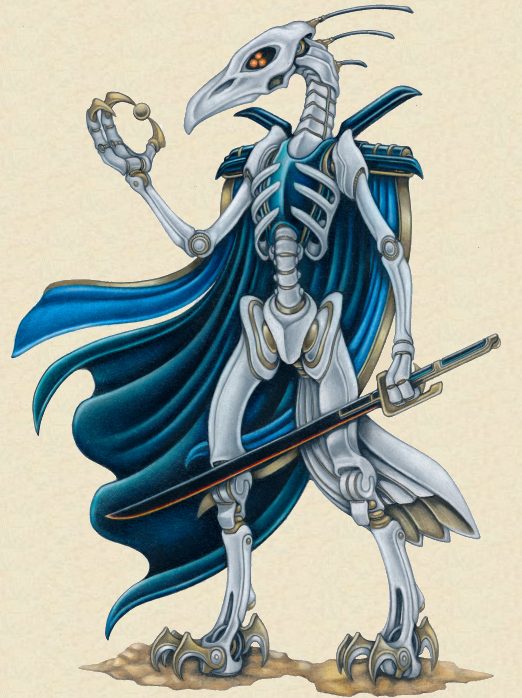 |
N-MACHINE Run Dead: With all their living parts replaced with metal and crystal flesh, these kuil surrendered their mortality for a false afterlife of tailored delusions. They altered their own perception of the world and saw it as they saw fit. The phantasmal force of their perception was idyllic at first, filled with heavenly pleasures only they could perceive, but as their world burned the illusion faded and with it their sense of peace and permanence. Aethos promised them eternity, and never failed to deliver, even when the package lost its benefits. Those who broke free of Aethos were given the ‘N’ designation (Neuron), or just ‘Neural’ to indicate their non-allegiance to the machine god. They are free-willed undead, in other words, and simply a re-skin of the Warforged or Skeleton depending on which template is used in their creation. The rest is just the worldbuilding around their history. Cold Calculator: Without the limitations of an organic mind and all its messy secretions, Machines are exceptionally-fast thinkers and act on thought almost instantly. Their assessments are predictably stark and often disheartening, though they do experience some degrees of broken passion and even optimism in rare circumstances, showing the faded remains of who they used to be. These are the actions of a haunted spirit more than any cohesive personality, and to portray a Machine is to guard and deploy these traits as the only thing which keeps them from falling entirely under the control of Aethos. Those who do become entirely ‘cold’, the last of their personality emptied out and replaced with some decrepit lower purpose within the ruins of Axis. All That Remains: The original soul, so to speak, is a dying ember. All that remains of it is tied to the former life, woven into skills and trades more than simple sentiment. Machines remember what they did more than who they were, though the two are inextricably linked in ways that Aethos could not entirely purge. Even the most dedicated military Machine remembers the emotional fragments of being drilled, of saving lives, or taking others, of eating with friends or holding the line. These fragments are what give them what passes for a personality, even if it’s just expressed in catch-phrases or in fits of what could be called rage. Some even attempt to rediscover this purpose and hold on to what they have left, seeking living companions more than their own kind and looking for meaningful ways to end their existence as ghosts seeking eternal rest. Most don’t even remember their own names, having shed them in their mechanical apotheosis. Machines have a wider degree of skill and knowledge of the ancient world and attempting to explore it without their guidance is a recipe for disaster. Even their faded memories are more reliable than the journal of an experienced dome-delver. Most Machines take a bitter sort of pride in showing the new world what remains of the old. Limited Memory: When the brain and hyphael are fused into a mineral phylactery, certain things are bound to be lost. The engram transmission was never perfected, and many kuil were reduced to zombie-like simplicity, their higher brain functions utterly destroyed. Most can only remember the last century in specifics, with everything else being a blur of form and function. Memories can be erased at will, making Machines virtually immune to any sort of trauma or past grievance. In fact, without the organic chemistry of passions and fears, Machines have the unique ability to completely remove any unpleasant memory they wish. They cannot erase skills and other important functional elements, but they can dump anything else with an innate, unlimited ‘Modify Memory’ command. Any ten minute block within the last year can be removed or altered, though they refrain from over-use of this function as it can lead to dangerous and provable delusions which affect their highly-prized credibility score. Ability Score Increase: Your Intelligence score increases by 2. Age: You do not age, though parts wear out. Alignment: Most Machines are neutral, though they may be benevolent or pragmatically cruel in equal measures. The original personality loses all Chaotic elements and may not change to any form of Chaotic alignment, even by force or corruptive influence. It is impossible. Size: Machines are slender and skeletal, though they may be bulked up by the crystal flesh they wear over their mechanical bones. They are Medium. Speed: Your walking speed is 30 feet. Darkvision You can see in total darkness as if it were bright light, though the image is greyscale infrared. Heartless: Death, bleed, disease, sleep, and fear effects are useless against Machines.
Modular: You can lose limbs and even your head without dying, though such parts must be carefully repaired and re-joined by either another Machine, or an Arcanar Wizard.
|