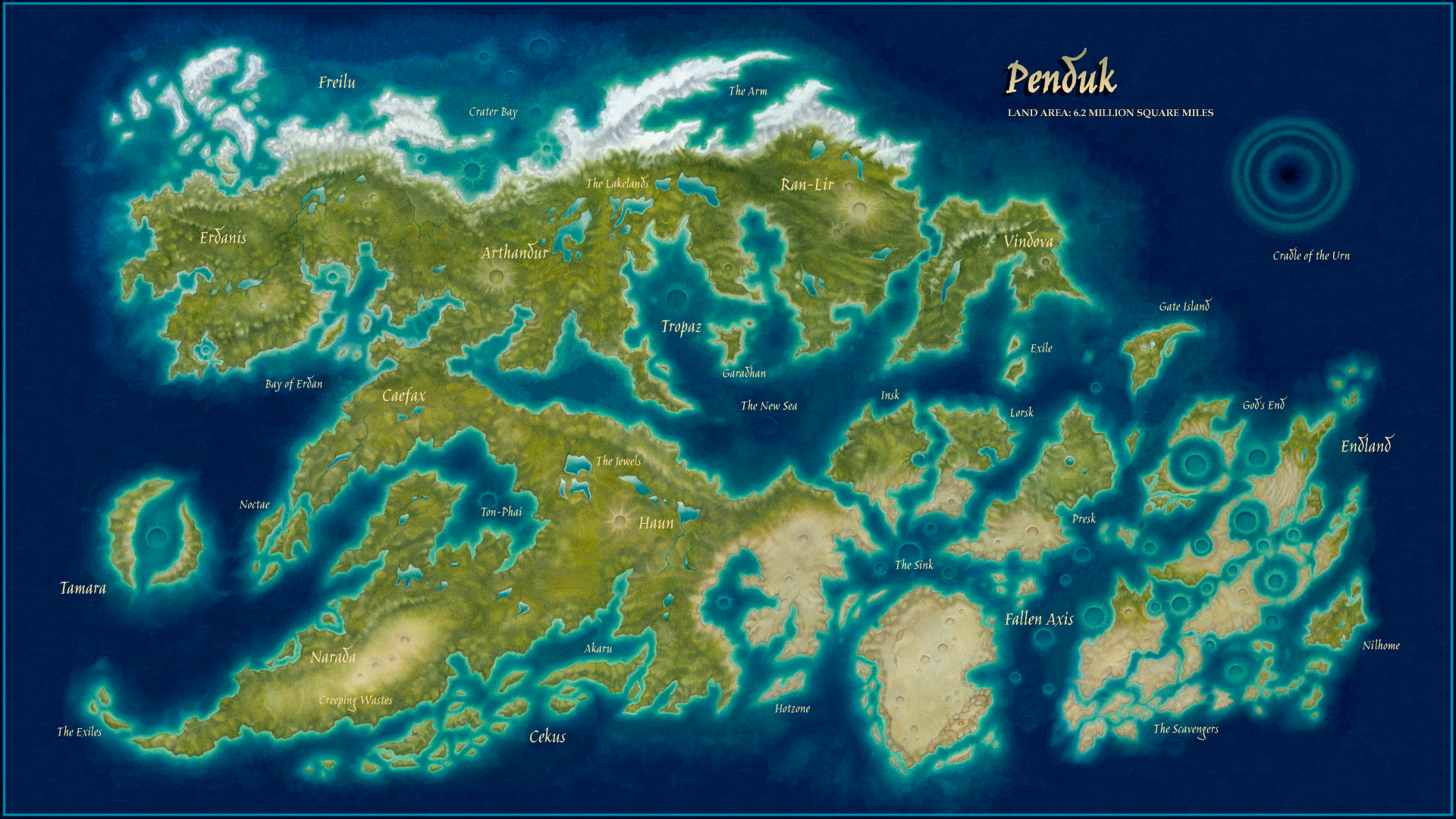
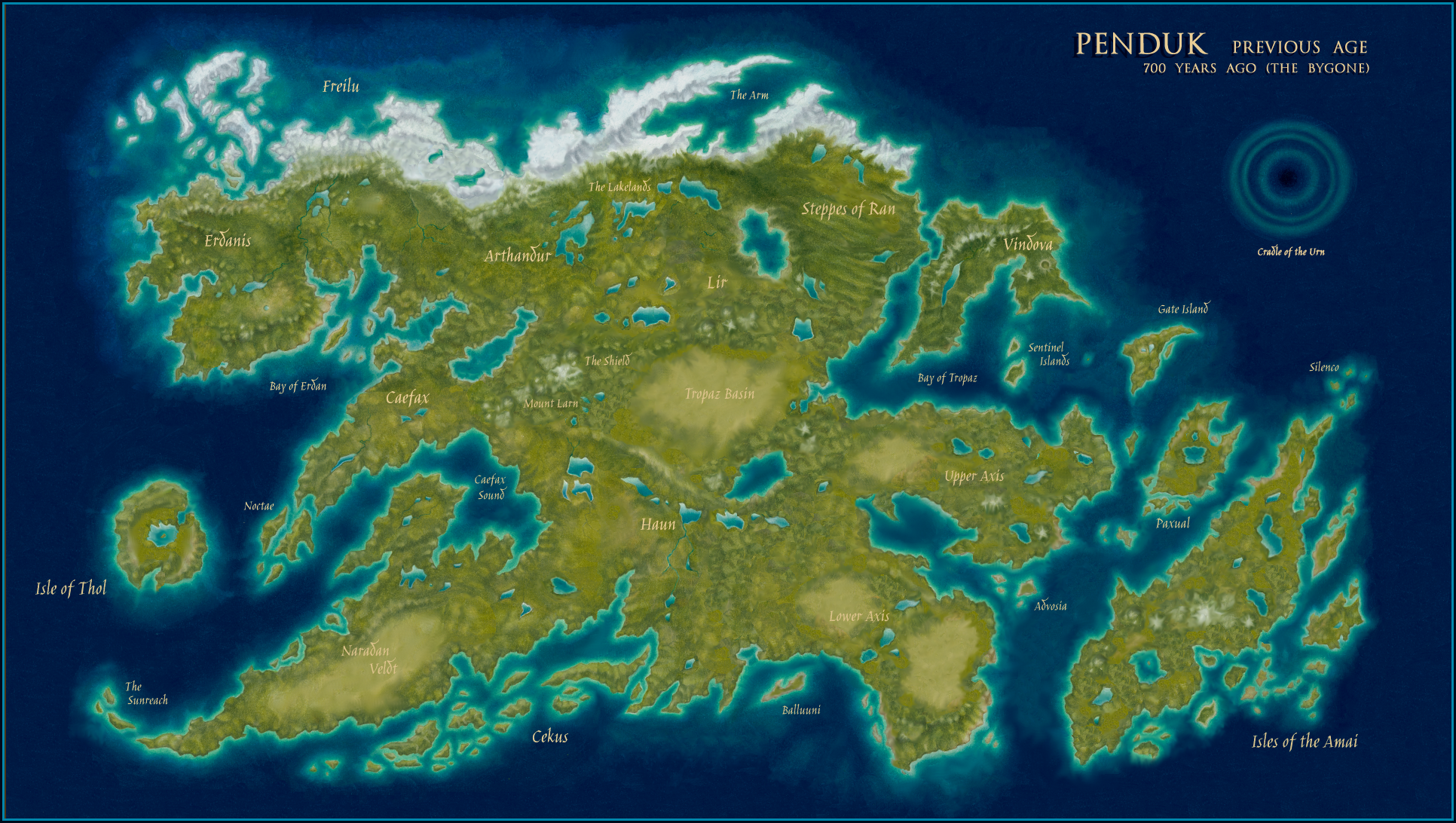
Rym’s largest continental mass is Penduk. Its climate ranges from sub-arctic Freilu to tropical Cekus, with a number of unstable wasteland regions still recovering from the great Automatic War seven hundred years prior to the current age. The world is sparsely-populated, its inhabitants having only recently reclaimed the land from the utter ruin of the previous era, the so-called Golden Age in which the Creator State grew powerful enough to challenge the divine will of the Amai, Rym's ruling caste of demigods. This is the era now referred to as 'The Bygone'.

      The weapons and aftershocks of the Automatic War caused roughly a third of the continent to break apart and sink. The New Sea itself was once a vast underground domain, while the divine paradise now called Endland best demonstrates the sheer destructiveness of the conflict. These cratered areas are shot-through with jagged fault-lines, chasms, and geological upheavals where the shockwaves of the war are recorded in the very landscape. The visible profusion of craters, called ‘tons’, are distinguished by their unnatural size and shape, caused not by impacts or explosion but by the wholesale disintegration of entire regions, and subsequent collapse of the surrounding landscape into the void left behind. By the late third age, shown here roughly seven centuries later, Penduk is well on its way to ecological recovery. The ruins of The Bygone are largely crumbled away or overgrown, though there are some regions where the lost Creator State remains clearly visible, with remnants of the old world still exposed. This is more common in the southern region where the war was concentrated, and in other regions deep underground, where forgotten shelters became tombs for the majority of the conflict’s would-be survivors.

      There are belts of smaller uninhabited islands in the vast southern ocean, though anything below the equator is regularly swept by the moon Zunat’s perigee wave, which almost nothing can survive. This phenomenon forms a near-impassible barrier to exploration of the southern hemisphere, as its atmospheric compression is powerful enough to destroy even airborne vessels. In mythological terms, it was the world’s edge, a wall raised by the passage of the gods, and a demonstration of their power. This is the Lunar Wave.


THE ISLAND OF KOAU

      You’ll see a lot of craters on the map. These are the places struck by Nigh’s Fourth Light during the Automatic War. Unlike ordinary craters with a central uplift, the telltale sign of a ton is the black void at the center, and the residue of dead divinity around the rim. This is where the old gods died, and even seven hundred years after the war they remain a dangerous hazard. So-called ‘ton craters’ are regions of dimensional instability and unpredictable supernatural phenomena, the result of divine matter annihilation by the Fourth Light. The explosion of this matter flashed its residue upon the surrounding landscape and left a black burn called a ton-heart, or ‘Strange’, where space and time appear to be, well…strange.

      Each ton-crater represents the destruction of a divine being, or demigod, and so each has its own unique residue and associated strangeness. This residue is thought to be responsible for the proliferation of mutants (sorcerers) whose abilities mimic to some minor degree those of the slain entity. Those born close to the crater have a higher chance of developing under the influence of this residue, especially during ton-storms and Strange-flares, events which keep most settlements far away. The craters are slowly starting to fade along with their residual strangeness, though many pose an active and unpredictable threat to the people of Rym.

       Storytelling: If you want to bring in characters or objects from other worlds, this is the plot device for you. Ton-storms are regions where the walls between worlds are damaged.


THE KIJIAN SYSTEM

      There were six planets orbiting this orange dwarf star until the Urn arrived, pulling outermost Suul along with it. Now there are seven, three rocky inner planets, two gas giants, a frozen ocean world, and the Urn’s outer reliquary, aforementioned Suul. Most of these have their own moons and further details (mouse over any of them), and serve as story backdrop, astronomical detail, and even places to go if you’ve got the right stuff. The star itself itself is enclosed within a much larger nebular void, and is difficult to observe directly from neighboring systems. Right now, we're on Rym, third from the sun.

      Of these worlds, only Vauz and Rym harbor life. Both were shaped by the Urn, each with its unique biomes and populations, and each overseen by voiceless, incomprehensible moon gods called 'Onai'. These giant sculptures exist on Rym's smaller moon, Zunat, and on Vauz's sole moon of Talionis. They alone know the Urn's purpose, though without their intermediary demigods, they're unapproachable. The rest of the system is devoid of life, with the possible exception of oceanic Naiyos, which drifted out of the star's habitable zone and froze solid.

      Storytelling: It’s good to have some local astronomy, not just for the sake of an interesting night sky but so that the various cultures can have strange notions of what might be up there. They can be used for navigation, a source of legend, or even days of the week, though in this case they’re also good stand-ins for elemental planes of various sorts, and may be relevant in the case of visitors from other worlds.

Chash (Planet) Vauz (Planet) Rym (Planet) Bauj (Planet) Shuj (Planet) Naiyos (Planet) Suul (Planet) Erdanis (Country) Arthandur (Territory) Ran-Lir (Country) Tropaz (Country) Freilu (Territory) Vindova (Country) Caefax (Country) NARADA (Country) HAUN (Country) AXIS (Wasteland) CEKUS (Archipelago) ENDLAND (Archipelago) Tamara (Islands)