





|
|
|
|
Rym’s past civilizations and cultures left behind an odd assortment of wondrous items, weapons, consumables, and other relics which could be considered ‘magical’ or at least misunderstood. While many settings contain ornate enchanted weapons, armor, wands, and so forth, much of what you see below is just a sample of the anachronistic oddities one might find in scavenger bazaars, ruined shopping complexes, or the hands of the misguided. Some are repurposed or inappropriately-rebuilt, and many are mistaken for something they’re not. Others are well-understood, coveted, or even restricted by the deservedly-maligned Arcanar Guild, who seek to collect them and return them to Decider’s hoard in the Tamaran Triad.
Repurposed: These items are mostly made from components or misunderstood objects which have a new (often simpler) function in the current era. Some are cobbled together by the Arcanar Guild, though most of them are simply adopted by whoever might find them and fix them up to varying degrees. Items like this have a hybrid look, such as the Foamthrower or Springshot, combining old and new materials in a distinctly janky sort of way that allows them to pass relatively unnoticed by the Arcanar, who have lists of what is and isn’t allowed to be in the possession of non-Arcanar. Original: These are the real relics and wondrous items of the Bygone. Anything that’s been preserved in complexes filled with Quiet Air, or in private collections, or even in Arcanar Guild colleges where the restoration process has been perfected. They’re shiny, often garishly-coloured, and in perfect working order. Items like the Electrobike or Fiche Reader are examples of items that need to be in such a state for proper function. They may have a few cosmetic enhancements, but for the most part they appear as they did in the stores and catalogues of Rym’s golden age. These items will get you in a lot of trouble if the Arcanar Guild catches you with them. A permit is needed just to salvage and transport them.
|
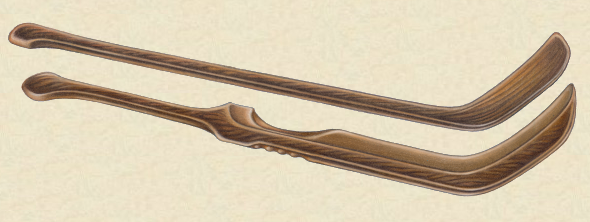
SHAUSHUA AKTAK SPORT STICK This is the aktak, or ‘attack stick’. It’s derived from the sport of the ancient world, a relic the lutrai carried with them from the ruin of Rym’s second age. Its form and function have evolved over the last seven hundred years, now serving as the staff or two-handed club most commonly found among the Shaushua clans of eastern Arthandur. They also use it to play a bizarre version of the original game for which it was once intended – Aktak-Ru. Players will generally carve and decorate their own, and thus the ones shown here are very fresh, blank templates to which paint, carvings, and lapidation may be applied in recognition of victories and feats of great prowess. It is very hard to find a Shaushuan without one, and even other tribes have been known to adopt the game and its culture. The aktak is made of warwood or similar dense, resilient timber, allowing it to absorb a great deal of shock. It can be used in close quarters in much the same manner as a club or staff but its true potential lies in what was once known as the ‘slap shot’. This involves the delivery of a rock or other small object at incredible velocity, and could be thought of as their version of the sling. More often, the aktak is used in sport and not designed to inflict lethal damage. Shown here are two versions – the one on top is the ‘striker’ stick used by most players, while the heavier greatstick is used by the team’s defender, either by itself or paired with a dome buckler. Details: The aktak is a very versatile item and has many uses outside of sport or combat. It’s long enough to poke something dangerous from a distance, strong enough to jam a door, hard to break and simple to make. Moreover, it tells a story, and by examining the totemic carvings, painted lines, and curved notches it’s fairly easy to determine the player’s history and even their style of play. Many become treasured heirlooms, though in most cases, a lutrai is expected to carve their own, and come to know it well enough to re-create its every last detail if it’s lost or broken. This takes many days, and requires a lot of work.
Mechanics: This is a quarterstaff or a greatclub which can also function as a sling with half the usual range. Unless specifically made for battle, all aktak sticks inflict non-lethal damage. The striker stick can also be used to trip an opponent by ‘hooking’, a forbidden move in normal play. The implement is surprisingly hard to break, especially when made from traditional materials and treated with the proper substances.
|
|||||||||||||||||||||||
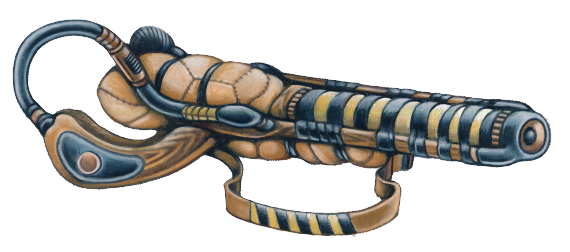
FOAMTHROWER WAVER CARGO CULT DEVICE Made (in part) from the amazing materials furnished by a crashed aerodyne, the foamthrower is an imitation of a famous fire-fighting device of the previous era. It’s actually just an arrangement of two rubber-lined leather bladders and a squeeze-pump to mix their contents. The resulting chemical reaction is then spewed out through a reinforced nozzle at high pressure. This is usually foam of some kind, ranging from utilitarian to recreational, and in a wide ranger of colours. Several of the more exotic formulae remain in circulation, such as the dangerously-amusing (and flammable) Balluuni FunFoam, and the infamous pink nitrous oxide foam called ‘Party Atmosphere’ This is a collaboration between lutrai and ixis designs, and an example of how nilkind work together to produce unique fusions of their craft. In this case, ixis traders would hand the necessary parts over in exchange for rare medicine and kaufi, which doesn’t grow in Vindova. They only need to contribute a few metal parts and chemical pucks, and the rest is natural material. The lutrai have also mastered several basic formulas such as the CO2 foam they use to blast fires and the cleansing foam meant to wash large things. They can be made in the usual alchemical crafting process, though more advanced reagents require more advanced crafting conditions. Details: These are rare, though the Wavers made several of them in order to enjoy spraying each other with foam. They also used them to fight fires and even to fight certain creatures, though the options are limited by the available foam. It’s mostly a support item as opposed to a weapon, though blessed holy foam could be dangerous to some, and certain monsters will flee at even the possibility of a bath. The device is heavy, awkward, prone to issues, and will occasionally explode in a huge mess of foam. This happens on a critical fumble or failed Alchemy check.
Mechanics: This can double as a variety of different wands with appropriate foam-adaptability. For instance, it could be a Wand of Fog Cloud with one set of charges (chemical pucks), or a Wand of Grease with another. The pucks in this case act as the 'scrolls' that are the device's ammunition, and can be found in all sorts of odd binary-lobe packaging throughout Rym. Recreational Foam has a range of 30' and may be adjusted to either line or a shorter 15' cone dispersal by twisting the nozzle. It can actually be used to quench all non-magical fires in its area of effect, and even magical fires if the user's ranged attack roll is higher than the caster's level check. Or if the caster gets sprayed in the face while trying to concentrate.
|
|||||||||||||||||||||||
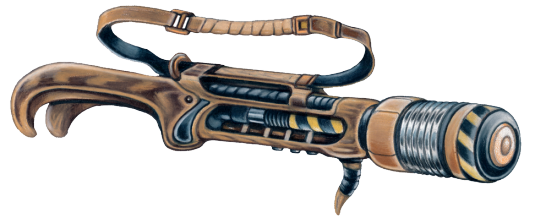
SPRINGSHOT WAVER CARGO CULT WEAPON The Springshot or Springram is repurposed metromet suspension coil, often industrial grade, housed in a shoulder-mounted frame. Though seemingly-ridiculous at first glance, the device is capable of bashing down a door or knocking down a charging beast, or even launching a companion with proper protection. Springs of this type are so powerful that they can kill, so the traditional ‘danger stripe’ is painted over the portions where the kinetic energy is stored or absorbed. When used properly, the springshot can either launch an item at great distance, or propel a heavy weight called a ‘bunt’ through anything that’s in your way. The bunt may be substituted for other objects, though anything that isn’t as hard as a rock will likely be pulverized on impact. This is a cargo cult version designed by the Wavers of Koau. They extracted the spring from the landing gear of a crashed aerodyne, and added a shock-absorbing piston to prevent the inertial recoil from sending the user in the opposite direction when employed. This one was used to break open cargo containers that washed up on their shores, or else protect locals from large rampaging predators. It needs to be manually reset, though multiple spring canisters can be kept in reserve. The device isn’t terribly complicated or difficult to build, though the kinetic energy it contains is quite dangerous and can misfire with disastrous consequences. Details: If you can find a broken-down vehicle and the correct blueprints you can probably make one of these, or the simpler versions anyway. The springs of the old world were made of metromet, or ‘city metal’, which was an atomically-perfected form of high-carbon steel. Coils made from metromet could absorb enormous amounts of stress without deforming, and while too expensive for full-scale construction, it was exceptionally-useful in mechanisms such as clockwork and in weaponry of all kinds. The other component was the shock-absorber, a piston of other kinetic sink to contain the inertial recoil. Without it, the device could send the user flying backwards when fired.
Mechanics: There are two version of this device. The lesser variant at low levels allows its user to deliver a Shove or Bullrush maneuver with a Strength of 24. This will perform a knockback appropriate to the result of the roll, typically pushing the target back 10 feet or more. It may also be used to create the Launch Item cantrip. Either use requires 1 full round action to reload. The more powerful version is the Springram, which acts as a Ring of the Ram. This version uses a powered piston which has charges just like the magic item it imitates, and is employed by the Arcanar Guild to smash people who displease them, or to punch through barriers between the user and anything they may want to get their hands one.
|
|||||||||||||||||||||||
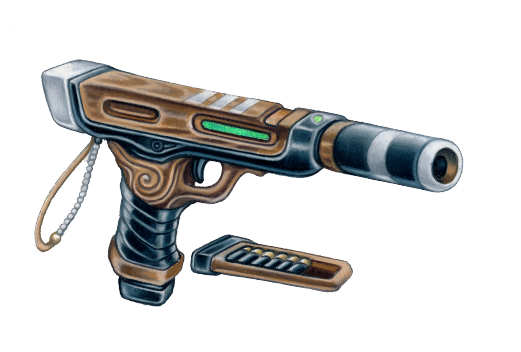
REPLICA WAVER CARGO CULT WEAPON This is an example of a replica, a fake gun made to imitate the real thing. The lutrai of the Waver cargo cult made a wide variety of these, though they can be found among any of the tribes in close proximity to wielders of the real deal. For the lutrai, such ‘guns’ are used more as the focus of a bizarre form of ritual combat in which everyone agrees to play dead if shot. Over the centuries this imitation warfare has evolved to such a degree that they can inflict non-lethal damage on each other at range. This works in much the same way as illusions which inflict ‘damage’ by mutual acceptance. There are rules, of course, and codes of conduct, but in general the idea is to participate in combat that doesn’t actually kill anyone. Various pyrotechnics and other relatively harmless projectiles may spice it up a bit, but the damage only lasts about 10 minutes, allowing those killed in battle to get up for the next round. Anyone can play this game if they agree, essentially eschewing their disbelief in order take part. Replicas come in all shapes and sizes, all of them imitations of the rifles and side-arms of the Automatic War. There are kinetic and energy-based variants, some of which are quite realistic and ornately-crafted, which is essential in maintaining suspension of the aforementioned disbelief. They even have limited ammunition or battery charges, and after hundreds of years this form of combat is so precise that cheating is literally impossible for them. Details: Replicas may contain fragments of real firearms, though nothing functional is required. It only needs to look like a gun. However, when enhanced with various substances or sound effects, a group of lutrai with these weapons may frighten off or discourage actual opponents by displays and flourishes of shooting skill. In truth they’re just acting out the subliminal weapon training imprinted upon their ancestors, and finding an outlet for combat instincts that no longer serve the long-ago Automatic War. Many lutrai may appear to be armed with dangerous weapons when in fact they’re perfectly harmless.
Mechanics: If both sides of a ‘conflict’ agree to engage, these weapons are treated as regular automatic pistols, rifles, laser pistols, or laser rifles – these all have real Pathfinder and 5e equivalents, up to and including range, effects, and ammunition capacity. The damage they inflict is imaginary, however, and they don’t work on anyone who hasn’t trained in (or agreed to) this style of training combat. Lutrai in particular have such a strong imagination that the damage inflicted and received is enough to render unconsciousness. The replica must fall within the range of known models and appearances in order for this to work – nobody’s allowed to invent a new weapon or extend the capabilities of an existing weapon beyond the norm. Note that tribes who play this game have proficiency with actual working models should they acquire them.
|
|||||||||||||||||||||||
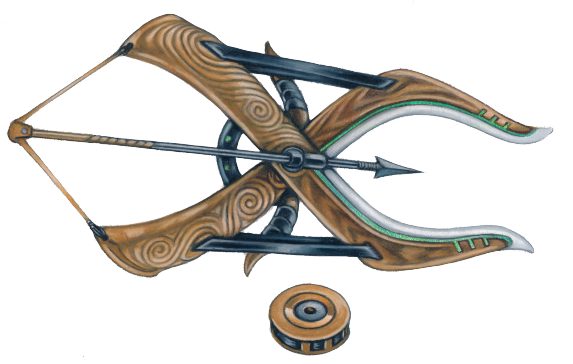
SNICKER FISHING BOW The fishbow, or snicker, get its name for the distinctive ‘snick’ sound it makes when fired underwater. The dart is propelled by the bow’s band-drive scissoring action, with a range of about 20’ feet underwater and 30’ feet on the surface. Darts weren’t intended for flight in air, being heavy and unfletched, though they may be attached to a reel of fishing line so as to pull in the catch. Snickers aren’t hard to make, requiring some basic ingredients along with the native X-rubber found through the Cekus Archipelago. Most young lutrai will build one at some point, even if it’s just to prove they can. The blueprint is stuck in their mind, like many forgotten relics of the Automatic War. Like a bow or a slingshot, it takes two hands to shoot a snicker, though they can be worn across the back of the wrist like a shield when not in use. The snicker can also be used to spear and reel-in small unattended objects, allowing the wielder to fish for pouches, books, food items, etc. The line is made to hold about 10 pounds, the average big fish, but isn’t much use against anything bigger. There is also a type of poisonous clay cap which can be moulded over the dart-head, drawing venomous ribbons through any wound it makes. This is used for larger, more dangerous predators as opposed to prey. Details: Snickers aren’t often ornamented, though some are inlaid with phosphorescent piping to supplement aim or to draw curious fish. The rubber elements are incredibly tough and durable, military grade by the nature of the artificial plant from which they’re derived. Darts are usually wood, though some lutrai will trade to acquire antennas and cycle spokes which travel further underwater. The line is usually made from silk or gut, though they also welcome genuine FGP which is much lighter and virtually invisible underwater. The wooden blades which form the scissors are quite thin, hard, and coated in a very glossy shellack which is further oiled to ease the action.
Mechanics: This is basically just a half-range shortbow that works underwater. In all other respects it's similar, with the possible exception of the fishing line it can pull behind it. In game, this is a useful item for snatching things in the same manner as a Mage Hand or other light telekinesis. It isn't strong enough to disarm an enemy, but it could seize something they're about to grab and yank it out of reach. It can also 'fish' creatures under 10 pounds, acting as a combat grapnel and tethering them if struck. This works in and out of water, and can also be used to retrieve darts which miss.
|
|||||||||||||||||||||||
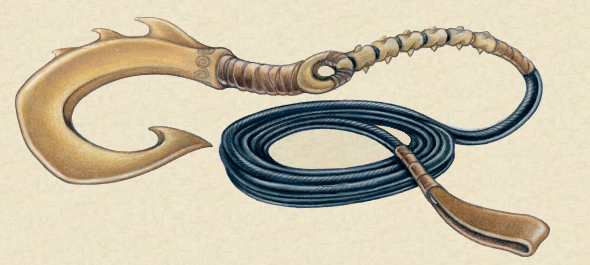
AKTA'NAUI BIG HOOK RANGED GRAPPLING There are some fish you just can’t catch with your hands. Sometimes you need the Big Hook. These are usually about the size of a hand axe, carved from baleen hardbone and treated for extra durability. With the right chum you can catch things that would bite your arm off, though an equally-impressive fishing cable is required to complete the implement. Most lutrai fishers will connect the other end of the cable to a catapult winch capable of breaking the prey’s neck instantly, though some are brave enough to hunt sharks with just what you see here. The back of the implement is thus equipped with embedded spikes, spines, or claws for closer encounters.
This big hook shown here is a combat grapnel. Lutrai use it to pull targets from land into water, often as an ambush group surfacing near boats, docks, or step shores. The hook is particularly effective when combined with waiting nets, making their use more common among groups of coordinated hunters. Most have a range between ten and twenty feet, though the hook itself can be wielded as a hand axe if necessary. The cable is usually worn over the shoulder, with the looped end around the wrist.
Details: The Akta'Naui use these hooks to 'fish' items off of ships which pass through their waters. At night, crews have to listen for the sound of these hooks landing on deck, or the scrape of objects being dragged overboard. Pirates need to be doubly-alert, as they may also be hooked and dragged away by those who wish to learn about piracy. This is often accomplished with bait, however, usually something that glitters.
Mechanics: This is a combat grapnel with a 20' range. It can be thrown to snag a target in flight or in the water, though it may also be sneakily hooked to the unaware in some way. Otherwise it functions just as well as a climbing aid, though a second cross-hook piece is most often added in this case. Lastly, it can become the business-end of the aforementioned catapult snare, which does exactly what you think it does.
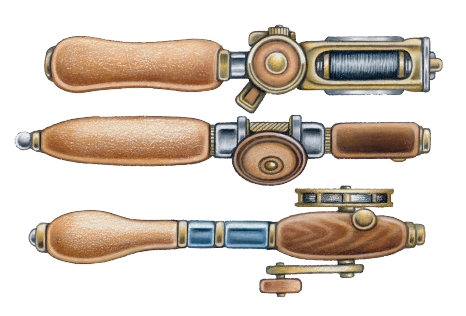
Though they vary in appearance and mechanical function, most of these do the same thing – they allow you to reel in the catch. Some are made for light, easy lunch-fish, others for the long struggle required to land a real monster, but they all share similar impressive mechanical construction and may be disassembled from the reel cartridge and rod for easy storage and build-swap. Some lutrai will have a box of several and can show a breathtaking degree of innate knowledge when it comes time to put them together or take them apart.
Details: These items require a variety of components that aren’t made anymore. This means that lutrai who want one need to trade for it, or even venture out into the wider world in search of the right pieces. They do this in much the same way as an enchanter seeking the materials for a legendary weapon. They might take pieces from a dead Machine, for instance, or other mechanical apparatus, assembling them little by little until the final result is ready for the perfect cast. In some tribes this may even be a rite of passage or a gift to a prospective partner. Some lutrai have entire collections of them.
Mechanics: The lutrai fishing rod is second to none. Even the kuil had a hard time beating their understanding of the fish. As a result, Survival checks made with these rods tend to have considerable bonuses, or else cancel the Disadvantage imposed by the wilier specimens. The handle is only one of the components, mind you, stacking with other elements such as bait, rod, and line. When fully assembled, such a rod is the Holy Avenger of fishing, and even the greediest of gorgs will be known to pay ridiculous sums to acquire one for the bragging rights alone.
A wise man once said that the towel is among the most useful items a person can own. The monks have taken it a step further, adapting the towel to their unique martial art and employing it in flamboyant combat maneuvers, acrobatics, and interpretive dance. In the right hands it becomes a whip, a net, a garotte, even a shield, with few suspecting its potential at a casual glance. It can be dipped in water or other substances to add even more sting to the snap. It can also serve as a stretcher, be torn into bandages, or dry people off.
Details: Lutrai will often adapt the towel as a colorful garment, worn as a mantle, belt, sarong, or cloak. They are easily customized, and may even serve as the wearer’s coat of arms, though most are stowed in waterproof leather tubes to keep them clean and dry until they're needed. It is considered very bad luck to lose any towel, especially one’s own. They may be handed down but also serve as a funerary shroud. The monks make them from recycled Ultracotton donated by those who wish to acquire towels of their own. They are four feet wide, and nine feet long, and far more durable that an ordinary towel.
Mechanics: The monk’s towel can act as a whip when wet, or a club when weighted with a rock - its two most common configurations. The real value is in its unobtrusiveness, an improvised weapon whose techniques have been refined over the course of seven centuries. The Monks of the Moonwake specialize in various forms, even those using two towels at the same time, or towels so large they have to be wielded with both hands.
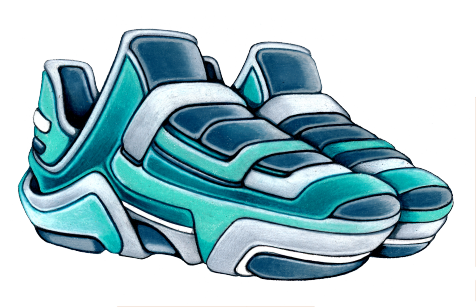
Autokicks depend on a charge, like most items of the Bygone, so they aren’t always active. The heels must be clicked together, whereupon the light bands between body and outsole flare up and the laces secure themselves for optimal comfort. Some models were even known to speak, though this proved less popular than anticipated and isn’t a common feature. They’re surprisingly durable despite their gaudy appearance, and tend to stand out in any crowd. As such, one must be cautious not to attract the attention of covetous Arcanar, most of whom would immediately seek to confiscate them for their own use or the considerable reward.
Details: These are so coveted that wearing them is rather dangerous. The Decider has an enormous sneaker collection and her obsession with shoes like this goes beyond her usual desire for advanced weaponry and missile components. There is an active bounty of 5000 pazools for intact pairs, and most Arcanar will recognize them instantly unless they’re cleverly concealed or used sparingly. Even non-Arcanar relic hunters have been known to kill each other to get a pair, and they’re among the only form of modern footwear that can be worn comfortably by any species of nilkind as well as kuil – they have modification straps which change their configuration to fit any foot.
Mechanics: This particular model stands in for Boots of Speed, allowing the wearer to sprint with unnatural alacrity. Like the boots, they may have a limited number of uses before a recharge is necessary, but are the same in all other respects. One minor addition is that they light up with each step while activated, shedding the same light as a candle and allowing the runner to illuminate their path. Unfortunately this only adds to their conspicuous visibility, but good luck catching someone who’s wearing a pair.
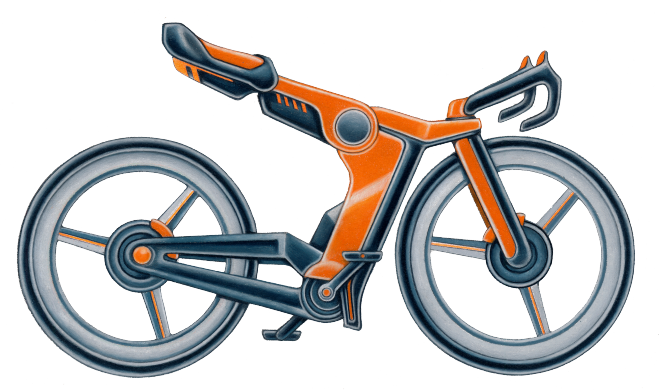
What really set it apart, however, was its power mode. For up to eight hours in one day’s charge, the Electrobike would power its own motion, allowing the rider to just relax and take in the journey. Power mode could outpace any mount and required only ambient sunlight to recharge, making it almost effortless to get from place to place. The only drawback is that if it wasn’t carefully locked or monitored, others could simply hop on and race off with it.
Details: This artificial mount is quite a popular item and one of the few that can be purchased from the Arcanar Guild without a lot of hassle. They prefer to rent them, of course, but if you have the pazools, they’re not hard to acquire. They’re simple to maintain, quite durable, and can be found with regularity within the ruins of Axis, often with their skeletal riders still clinging to the handlebars. Even non-functional units allow the owner a significant improvement over the classic ‘walking’ mode of travel. They can also mean the difference between escaping a hungry predator and being eaten by one.
Mechanics: This is essentially a 1/day Mount spell, an artificial horse that moves as fast as the real thing and requires no food or water. Some models, such as the Roadblaster, can trade 1 hour of ride time for a 1 minute boost, kicking the speed from 50 to 80 and making it possible to perform considerable jumps and other stunts which require Ride checks of varying difficulty. At full speed, a Roadblaster can outrun just about anything, and jump gaps up to 20 feet across with relative ease. The Roadblaster even includes an illumination device which acts as a front-facing bullseye lantern while in power mode. It does NOT function on difficult terrain.
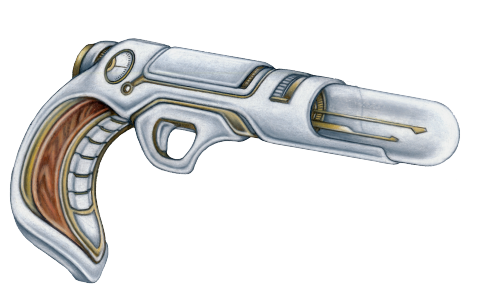
These days, Cancellers can be found among higher-ranking members of the Arcanar Guild, especially those who bounty-hunt enemies of the Decider. They are very distinctive and often flashy, decorated with gold and alabaster or other precious lapidation, and are as much a status symbol as a functional weapon. Possessing one outside the guild is strictly forbidden, and finding the rare and costly bulbs is quite difficult. Of course, being able to cancel magic with a quick-draw flash may be worth the risk and effort, as few casters are powerful enough to overcome the Third Light.
Details: Cancellers are a signature item, something one can expect to find with both Arcanar Guild masters and Machines, especially the Proxies of Nigh. They are often issued to members of the War Division, and will always have a very distinctive Q-bulb at the end. This bulb crackles and pops when discharged, an unmistakable sound that accompanies the blinding burst of violet-blue radiance. The bulb is then ejected, blackened and fused, and requires a fresh bulb before the device can be fired again. This makes it impractical for long engagements, but ideal for a quick and deadly reversal.
Mechanics: This is a Wand of Counterspell, or Dispel Magic (interrupt version) depending on the system. As a third-level wand, it’s extremely rare and expensive, but practically a requirement for high-level members of the Arcanar Guild or Proxies of War. It can stop a Fireball or Cure Serious Wounds as an interrupt, and should be used sparingly, as it requires a full round to reload even if another bulb is available. It does not regenerate charges, and bulbs cost between 500 and 750 pazools, making it a very expensive countermeasure.
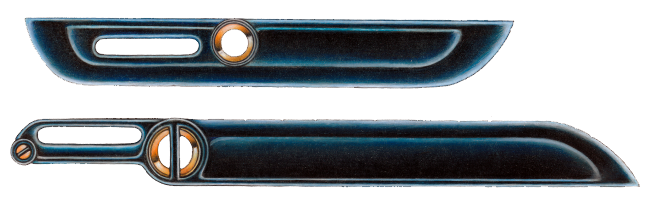
Feathers of Nigh, as they’re aptly called, are all but indestructible. There is simply nothing in the world which can break them, and melting one down would require a temperature no blacksmith could endure. Their substance is deeply unnatural, absorbing light and energy, and always cold to the touch. They’re legendary as weapons and few could possess one unchallenged, so you can be sure that if someone’s carrying one, they’ve killed to acquire it or keep it. The Decider has a bounty on these, an offer of an estate on Paradise Gold which is beyond any price.
Details: These are legendary, and not to be handed out lightly. They’re also a faint indication of Nigh’s mortality – it’s been flying for seven hundred years and though only a few feathers have fallen, Rym’s god of death may not be as eternal as some believe. These are the only blades capable of cutting into the ancient airframe, or shearing through the greater war machines such as Terrorpods and centipede tanks. They make a chilling moan when swung, and require a massive amount of strength to wield effectively. They break the atomic bonds of any substance they cut into, causing an unusual amount of damage, and they’re utterly immune to magic of all kinds.
Mechanics: The larger version, the Pinion, is a +3 Vorpal Greatsword with the added benefit of being able to destroy any form of magical barrier on contact (Wall of Force, Resilient Sphere, etc.). The smaller version, the Contour, is a +3 Sword of Sharpness with the same barrier-destroying quality. Both overcome all hardness, all damage resistance, and all forms of regeneration. Nothing can regenerate naturally for 1 full minute after contact, not even gods.
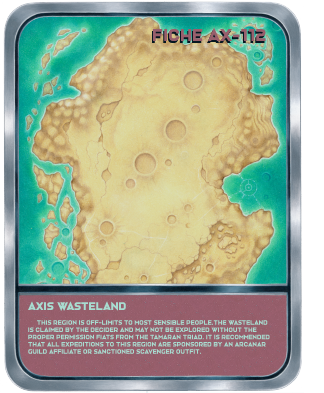
The item itself is just a frame and a magnifying crystal with a strip of illuminated luxic sandwiched between thicker panes of sapphix. It gets its name from its purpose – reading fiche-sticks. These are thin strips of layered semi-transparent FGP, or fantastic glassplastic, containing microfiche writing and images far too small for the naked eye. By inserting the fiche stick into the reader’s middle divider, the device can by used to magnify the contents for easy reading. A slider controls the position of the stick and thus the pages which appear on the display. Fiche-Sticks are quite small and easily transported, such that a significant library of knowledge may be carried in a single pouch or box.
Details: The Fiche Reader is how most literature was preserved across the gulf of centuries between the old world and the new. Existing readers and their sticks are extraordinarily durable, and serve the vital function of books, magazines, catalogues, maps, diagrams, and so forth. Fiche Sticks are incredibly valuable treasure for the most part, relics of a very literate and knowledge-heavy culture that wanted to make it easy to exchange information. They’re useful for lore-drops in-game and may even be so valuable as to be the sole objective of certain factions or individuals. Rare diagrams and blueprints are especially-prized.
Mechanics: Fiche Readers are extremely durable – you could smash someone over the head with one without breaking it. Most of them are about the size of a small book, sleek and thin, easily cleaned and maintained, with a relatively simple inner working. It’s really just a sophisticated magnifying glass with a permanent Light spell to illuminate the contents on the display. As such it can also be used to light the darkness as a candle would. It takes only a Standard Action to insert or swap a fiche stick. Sticks range from 1-200 pages and can no longer be made without a Fiche Writer, which is very rare.
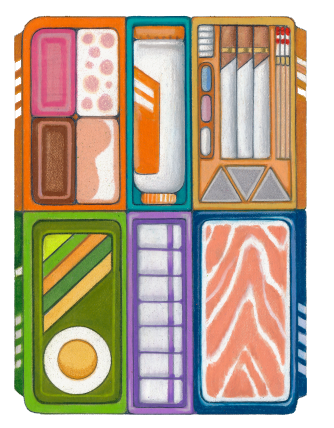
Details: The FlatRat was easily rearranged by colour-code and sorting pips, randomized to improve morale and very easy to distribute in the field. It could survive extremes of temperature, resisted all forms of known bacteria, and could be snaped apart and stored in different pouches for easier portion management. The discarded packaging was supposedly detrimental to enemy environments, though it could also be recycled into fresh units or ammunition casings.
Mechanics: This item was the iron ration of its day, able to feed even a large soldier for about 24 hours. Though it wasn’t as satisfying as a proper field kitchen meal, it staved off starvation, boredom, and anxiety and could be carried in large quantities without significant encumbrance. It’s also got a bit of money in it, typically for gambling or vendomats, and matches in case you need to start a fire. The water tablets purify even rank drinking water as per Purify Water. The caffeine tablets remove one level of fatigue for 1 hour.
Details: These came in thin octagonal black glass pill bottles with creepy-looking eyes on the label. They could be shared around with others but were typically rationed to individual personnel. Side-effects include jittery energy coupled with a vague euphoric confidence. They were mildly addictive, but for the most part they were considered safe for mass-consumption during the Automatic War. These days they formula is a jealously-guarded secret of the Arcanar Guild.
Mechanics: This is simply a Potion of Darkvision in pill form.
Details: These came in the standard ration slate, usually depending on the current theater. Anyone facing off against fear-using entities (undead, demons, cosmic horrors) could expect to find a few blue-n-golds in their ration sleeve. Side-effects included a sort of beatific calm that non-users found difficult to relate to in stressful situations. They also improved pain resilience, allowing the user to absorb more punishment in battle without losing their nerve. They're still being produced today and sold by the Arcanar Guild, who have several pill-presses which use blue chith extract.
Mechanics: This is simply a Potion of Heroism in pill form, levels 1-3.
Details: This one is particularly difficult to prepare, requiring caution due to the fish's hallucinogenic contact poison. A small quantity of this substance is actually desired, but the real trick is preserving the tail's false eye. The food is supposed to look at you, thus its nickname. This is supposedly quite good for the cultivation of insight or wisdom, though that might be the hallicinogen.
Mechanics: This fish improves the quality of Divination. For an hour after consuming the okta'bua, all magic of the Divination school is treated as if it were Extended. This means it lasts longer than usual, as per the Extend Spell metamagic feature. The DC to prepare this version of Okta'Bua is Suvival 25 or Craft: Cooking 25.
Details: This is your basic lutrai breakfast, very common in the South. There are several varieties of tetra and greater tetra, this one being the 'harlequin' species known for its bright pink metallic skin. The skin is irridescent and can be dried and crushed into a powder pigment for dyes and decorative gilding.
Mechanics: Naiyuka isn't the only way to prepare a harlequin tetra, but it's the go-to for anyone who's learning to make lutrai sushi. The flank is left with skin on and lightly poached or fried before it's added to the rice, a Survival or Craft: Cooking roll of 10 will suffice. It provides no other benefit aside from being quite calory-dense.
The albino jetperch is larger and much rarer than the already-rare silver jetperch, so much so that they're practically sacred, and often given inbdividual names. It's believed that these are the fish which survive for long enough to lose their silver hue, becoming quite large and more dangerous in the process.
Details: Catching one of these must be done by hand, as they've learned to use their razor-sharp dorsal fins to cut even tough fishing lines if they're caught with a lure. They will slash the hands of anyone who doesn't pin the fins with a deft, practiced maneuver.
Mechanics: Eating the sushi of the albino jetperch provides the same benefits as the Improved Initiative fear for 8 hours. This heightened state of alertness is punctuated by a strange, almost otherworldly state of calm. The DC to prepare this variant of naoyu is Suvival 20 or Craft: Cooking 20.
Due to its rarity, the golden moonbass is often saved for special occasions, and since only the female can be used to make okta’hani, a catch is no guarantee. The male moonbass is less flavorful and usually served as fish steaks fried in different flavored fish oils.
Details: It's very hard to catch a moonbass, and since they're quite rare, the lutrai take care not to overfish them. In fact, unless a feast is planned they're almost always thrown back - this is considered incredibly lucky, as the fish is thought to extend some sort of karma-inducing gratitude for its release.
Mechanics: This belief has some merit to it, even if it's just psychosomatic. If you make the survival check (DC 25) to actually catch one of these and then throw it back, you gain the benefit of the Lucky feat for one day, allowing you to re-roll a failed saving throw, ability check, or skill check up to three times. Otherwise it can be made into Okta'Bua and Okta'Hani (Suvival 20, Craft: Cooking 25).
The massive platinum salmon can feed a whole family, and though not particularly rare, they’re so big that they almost always need to be caught by teamwork. They swim much faster than a lutrai and require an incredibly strong rod to reel in, and some have even been known to yank those making the attempt straight overboard.
Details: These fish are practically revered, and their faces appear on totems, masks, and other decorative artwork due to them being the apex of most fishing endeavors. They’re often the subject of a whole fishing expedition as opposed to the focus of a single determined individual, and landing one by yourself might make you a legend, at least for a while.
Mechanics: If you manage to catch one of these and show it off, you’ll enjoy a +4 Charisma bonus among witnessing lutrai for an entire day. This is considered a non-magical benefit, more a circumstance bonus brought about by the awe of your fishing skill. It may also be due to the fact that they want to help you prepare it for an enormous feast. Note that this fish can also be used to produce the Salmon Club.
Since the dart is quite common, and easy to catch en-masse, this fish is a major staple of the southern lutrai diet. Its extremely nutritious, flavorful flesh can be made into a wide variety of fish dishes, though Cuakij, or sun-sushi, is the most common. The fish is laid on hot black volcanic rocks to sear, then laid on a bed of roe and wrapped with lakeweed strips.
Details: Since they school in large numbers, this fish is more easily caught in nets. It can be caught individually, of course, though most lutrai consider it to be a rather boring catch on its own, often tossed back for want of something more interesting or challenging. It’s the bluefish of the southern islands, and often kept in large reserve ponds near one’s home as an easy meal.
Mechanics: This relatively common sushi is the staple of a high-energy diet. Including it in your daily meal reduces the onset of fatigue for two hours, which is to say any fatigue effects can be ignored for an additional two hours every day. The downside is that eating it every day may result in the gaining of significant weight unless the energy is burned off – it isn’t for the sedentary. The DC to prepare this variant is Suvival 12, Craft: Cooking 15.
| |||||||||||||||||||||||

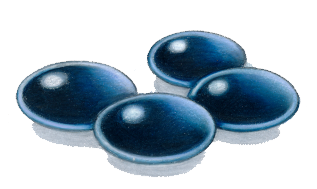 Often issued to soldiers and other personnel on nighttime duty, these pills were essential for anyone taking watch in the dark. They levelled the visual playing field with many supernatural entities, particularly denizens of the underworld or shadowy types like ghouls and ghosts. Ostensibly a recreational substance, they were tested first on the denizens of nightclubs, ironing out a variety of unpleasant side effects before being adopted by the military. Ocuplex was also essential for any kuil of nilkind partnered with cepn, who could already see perfectly in the dark.
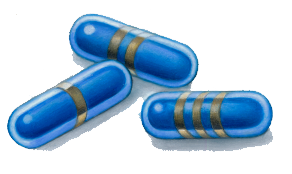 The enemy of morale is fear, and the enemy of fear is drugs. Specifically, this pill-based form of enhanced courage, also known as Calmitall. For scarier situations, there was also Calmitall II, and Calmitall III. All of these were available to the kuil and nilkind of the Automatic War, rationed out with the Flat RatPack slates given to front-line soldiers, sailors, and pilots expected to engage much scarier supernatural entities of various kinds. Calmitall III was so powerful that it was eventually restricted for making the subject a bit too brave.
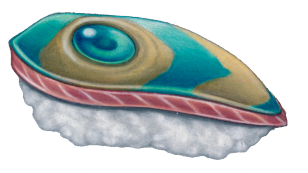 This piece is made with the false eye of the Golden Moonbass, a rare and conspicuous delicacy reserved for special occasions. Served without adornments or garnish, the so called ‘okta'bua’ or ‘eyepiece’ has a mildly sweet and tangy flavor and a delicate texture which includes that of the (slightly crisped) skin.
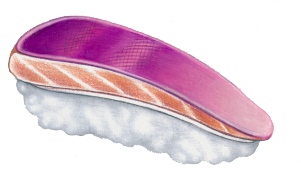 The flesh of the tetra is quite rich and fatty, and fairly easy to prepare. It can be cooked, salted, or dried, but here you see the more common variety of sushi on coconut rice, which is more of a breakfast meal. Because the tetra is quite small in the wild, lutrai will keep them in their house ponds and feed them generously to fatten them up.
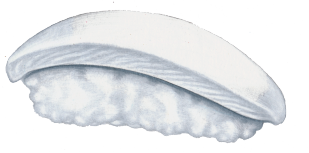 The rare albino jetperch is even more difficult to catch and prepare than its silver cousin, though the sushi is even more exquisite. Naoyu, or ‘moon flank’ is said to enhance the reflexes of those who eat it, and this may be due to the fact that to catch it one needs pretty phenomenal reflexes anyway. The flesh is quite firm and must be soaked in palm wine for several hours before being prepared.
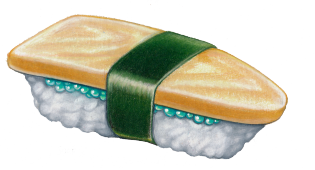 The aquamarine roe and golden flank-flesh of the moonbass is an exotic delicacy. Though it contains none of the hallucinogen-laced skin, its incredibly complex flavor profile is no less divine. The fish is quite large and a significant quantity of this sushi can be made to accompany the two eye-pieces. It’s wrapped with a single strip of kelp to hold it together as the roe is very slippery.
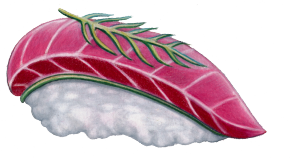 The sacred flesh of the platinum salmon is best eaten raw, with a sprig of sea-dill and a fern leaf. Sahuako is extremely difficult to acquire and prepare, though not considered to be a delicacy. Instead, it’s the hallmark of an extremely talented fisher, or at least one that’s been lucky enough to catch the basal ingredient.
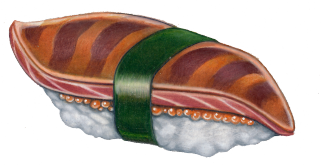 The fillet of the copper dart is laid over a layer of roe and a bed of coconut rice, lightly glazed in spicy fish oil. This is a warmer morsel, bound with a band of kelp and best eaten in a single bite. Cuajik is a more common dish, easily acquired and prepared. The skin is left on to absorb the spices and to give Cuakij is crispy, spicy texture.