





|
|
|
|
Rym is sparsely-populated. The Automatic War left the world in ruins for hundreds of years, and the descendants of its few survivors are shown below. They fall into three broad categories, the natural, the artificial, and the mechanical. Others may exist, of course, those who have fallen through ton storms from other worlds, though such alien curiosities have no significant population base outside of the Decider's menageries.
Newkind: These are thought to be the reconstituted remnants of six extinct humanoid civilizations, also called 'The First People'. They were the first inhabitants of Rym, brought from dead worlds by the Urn and introduced into its world-spanning sanctuary during the First Age. Only four of these remain to this day – the kuil (Rym’s humankind), the gorgs, the koba, and the c’zath. They are predominant, controlling most of the territory and shaping its political landscape. These species all bear the so-called ‘hyphael’, an essence or soul which linked them to the gods of a bygone era. This is an identifiable cerebral structure which set them apart from non-sentients. In essence, the hyphael is the black box of their lifelong experience, a record that could be read and judged by Rym's deities. As such, they were beholden to all forms of divine influence and coercion, and capable of channeling it in different ways. Nilkind: These are the mutant beings made by the kuil during the Second Age. In an act of rebellion against their divine wardens, the people of that era uplifted various animals to serve them as they had served the gods. These animals were made sentient without a hyphael, and were thus free of divine influence, whether fear, awe, or temptation. They were ‘nokind’, or ‘nilkind’, soulless adjuncts to the conquest of Creator State. The kuil used them to expand their dominion in unnatural ways, and to engage the fantastical remants of the First Age in open conflict. Several species of nilkind remain to this day, having earned the right of reproduction from their creators. They exist in 'duons', paired sub-species made for alternate purposes. The most common are the skoles, the cepn, the lutrai, and the ixis. They have no afterlife, though their offspring inherit an unusual degree of similiarity and aptitude from both parents in the hazy suggestion of reincarnation.
Machines: Though they may look like robots, the Machines are Rym's undead caste. They come in all shapes and sizes, counting any mechanical body that's been fused with a living kuil. During the Second Age, the kuil used this crude form of immortality to cheat death, though most who underwent the risky TI procedure ended up becoming zombies of a sort, only fit for simple labor or mechanical control. Other TIs were more successful, though only the most exotic, expensive procedures were able to preserve any degree of sentience and sanity. Most Machines are simple automation - doors, lifts, facility announcers, and so forth. Those with humanoid bodies and wills of their own are the ones shown here, Rym's 'intelligent undead'. They keep to themselves, inhabiting many of the ancient nicrete ruins of the old Creator State. Only in such places are they able to find the parts required to keep their old bodies running smoothly, either by salvage or cannibalism.
|
|
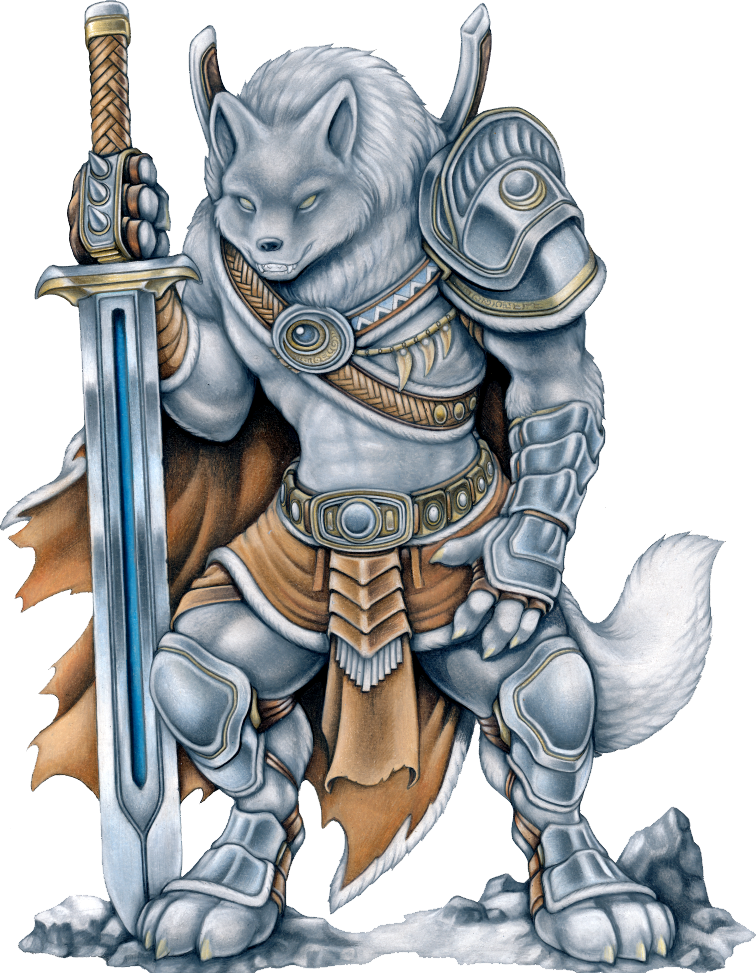
NORTHERN SKOLE FIFTH EDITON Physical Description: There are two broad species of skole, one being the wilder wolf-like northern variant, the other having retained more of their original domestic features. Both are somewhat larger than humans and considerably stronger. Northern skole bear predominantly lupine features, having adapted to colder climates over the centuries since the collapse of the Creator State. They are larger, heavier of limb and thicker of coat. Southern skole are leaner, more densely-formed and short-coated. They have adapted to warmer climes, and tend to have a more sophisticated bearing. Society: Skole society is rough no matter where you find it. Though the northern barbarian clans are renowned for their rough and rugged natures, the southern clans are no softer than their lupine cousins. Both cultures retain the militaristic shell of their former lives and purpose. They have done what they can to make a new society that’s all their own, but their crippling lack of art and culture was by design, and very difficult for them to overcome naturally. They have picked up a few new tricks along the path to independence, but the impression outsiders often get is that the skole are still clinging to the tenets of a culture that’s long-gone. They are waiting for something that will not come back. Relations: Skole may be gruff and serious-minded, but they do show warmth and affection to those with whom they share loyalties. In fact this is just about the only way to even get anywhere close to friendship with them, for they have no ‘casual’ relations. Few could be more loyal to cause or companion, though winning that loyalty is often an arduous, dangerous undertaking. They have no need for indirectness or tact, as this was the language and manner of the masters they’ve long since lost. Skole form strong pair-bonds, either by intimacy or battle, and can be honest to a fault. They rarely grant the benefit of the doubt to those they don’t know, but their acts of fealty and sacrifice in the face of adversity is as well-known as their innate mistrust of the unfamiliar. Alignment and Religion: Skoles have a strong predisposition to order, whether fair or cruel, and don’t do well with unanticipated deviations. They’re quick thinkers but often lack the creativity to anticipate or overcome chaotic situations. Those who follow any code of honor or ethics will do so with exceptional enthusiasm and zeal, however, and this can become contagious, especially among other skoles. As a result they will tend to gravitate towards strong leadership, with wisdom and charisma being every bit as important as martial skill or devotion. Their military origins make them ideal soldiers and followers, along with their formidable size and strength. Adventurers: Skole are constantly driven to prove their worth, both to themselves and others. They learn to see everything as some form of challenge, which helps them deal with their problems as ‘foes’. Great hunts, noble duels, and the conquest of terrifying natural obstacles will do for most, but others venture abroad in order to expand their horizons and their range of challenges. They don’t do anything easy, and have an unusually difficult time stooping to simpler challenges.
Male Names: Riorek, Ioris, Terek, Nelu
Female Names: Rigel, Seta, Farah, Shen
|
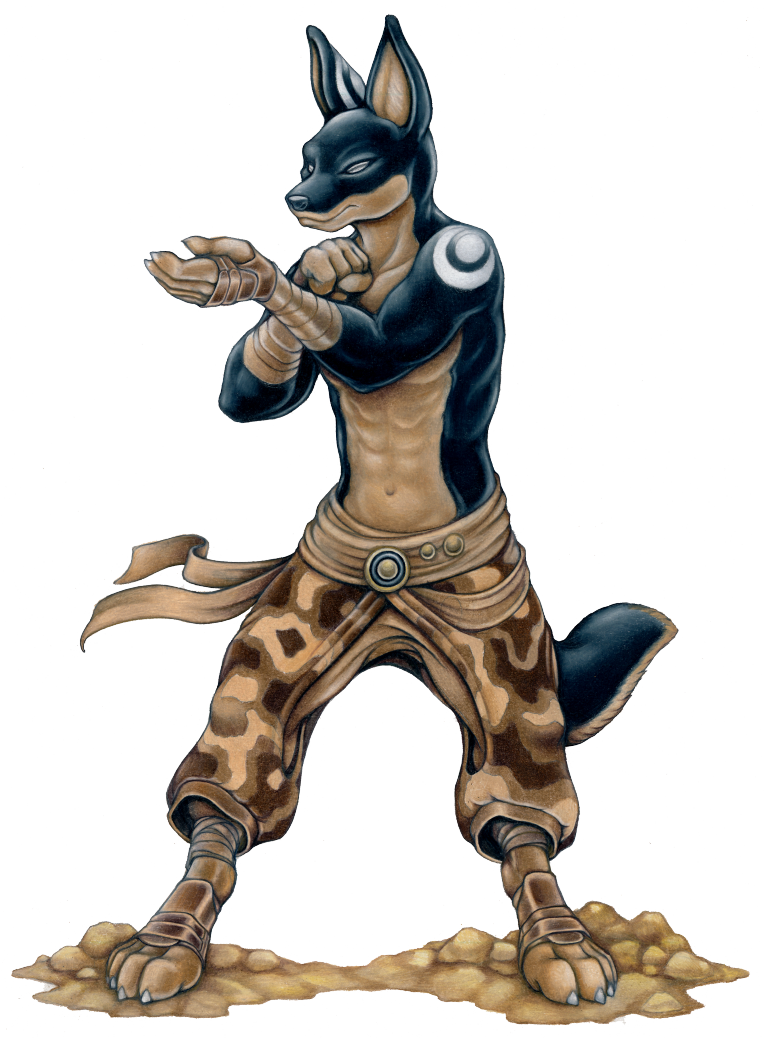 |
SOUTHERN SKOLE Physical Description: There are two broad species of skole, one being the wilder wolf-like northern variant, the other having retained more of their original domestic features. Both are somewhat larger than humans and considerably stronger. Northern skole bear predominantly lupine features, having adapted to colder climates over the centuries since the collapse of the Creator State. They are larger, heavier of limb and thicker of coat. Southern skole are leaner, more densely-formed and short-coated. They have adapted to warmer climes, and tend to have a more sophisticated bearing. Society: Skole society is rough no matter where you find it. Though the northern barbarian clans are renowned for their rough and rugged natures, the southern clans are no softer than their lupine cousins. Both cultures retain the militaristic shell of their former lives and purpose. They have done what they can to make a new society that’s all their own, but their crippling lack of art and culture was by design, and very difficult for them to overcome naturally. They have picked up a few new tricks along the path to independence, but the impression outsiders often get is that the skole are still clinging to the tenets of a culture that’s long-gone. They are waiting for something that will not come back. Relations: Skole may be gruff and serious-minded, but they do show warmth and affection to those with whom they share loyalties. In fact this is just about the only way to even get anywhere close to friendship with them, for they have no ‘casual’ relations. Few could be more loyal to cause or companion, though winning that loyalty is often an arduous, dangerous undertaking. They have no need for indirectness or tact, as this was the language and manner of the masters they’ve long since lost. Skole form strong pair-bonds, either by intimacy or battle, and can be honest to a fault. They rarely grant the benefit of the doubt to those they don’t know, but their acts of fealty and sacrifice in the face of adversity is as well-known as their innate mistrust of the unfamiliar. Alignment and Religion: Skoles have a strong predisposition to order, whether fair or cruel, and don’t do well with unanticipated deviations. They’re quick thinkers but often lack the creativity to anticipate or overcome chaotic situations. Those who follow any code of honor or ethics will do so with exceptional enthusiasm and zeal, however, and this can become contagious, especially among other skoles. As a result they will tend to gravitate towards strong leadership, with wisdom and charisma being every bit as important as martial skill or devotion. Their military origins make them ideal soldiers and followers, along with their formidable size and strength. Adventurers: Skole are constantly driven to prove their worth, both to themselves and others. They learn to see everything as some form of challenge, which helps them deal with their problems as ‘foes’. Great hunts, noble duels, and the conquest of terrifying natural obstacles will do for most, but others venture abroad in order to expand their horizons and their range of challenges. They don’t do anything easy, and have an unusually difficult time stooping to simpler challenges.
Male Names: Riorek, Ioris, Terek, Nelu
Female Names: Rigel, Seta, Farah, Shen
|
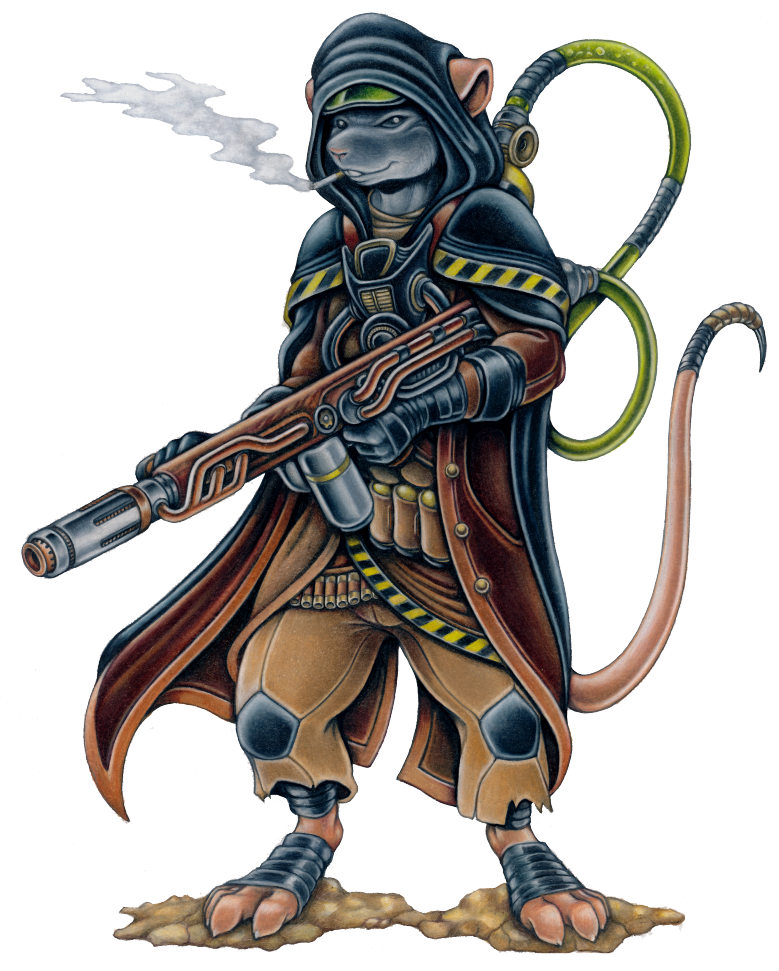 |
GREY IXIS Physical Description: There are two species of these anthropomorphic rats. Grey ixis are tiny, hardly bigger than their original ancestors, yet capable of manipulating the world around them almost as effectively as their larger counterparts. They work in large swarms, having been bred with certain clone-like features to minimize difference of both appearance and purpose. They range through the grey spectrum from shale-black to ash-white, and are distinguishable from normal rats by their organized ranks, miniature weapons, battle standards, and foul language. The larger brown species is still Small, but a giant compared to their cousins. Brown ixis are more broad-minded and independent, though they share the majority of the species’ rodent features, such as their long yet semi-squat bodies, long tails, and burrowing claws. However, their greater mass has thickened their hindquarters and strengthened their legs considerably to support a new upright stance. Both species have large, dark eyes, a rat’s muzzle, prominent incisors, and large, sensitive ears. They like ragged, functional clothing with an emphasis on pockets, sheathes, and hidden folds for their many, many possessions. Society: Shaped by the experimental regimens which uplifted them, ixis display an astounding ability to work towards a common goal, whether it’s to conquer a territory or overcome much larger adversaries. Unfortunately, this same trait makes them extremely manipulable, especially in groups, and their behavior will come down to who’s leading far more than it will for most. If a set of principles no longer functions within the group, they’re more comfortable adopting another than trying to think for themselves. For this reason, it’s never easy to know how a group of them will behave. In their native country, they’ve driven out all non-ixis long ago and have little outside perspective, seeing non-ixis as gigantic monsters or titans from distant lands. Vindova’s mountain fortress contains the (now sacred) facility in which they were first created, a site they have fully occupied and will never abandon. It is the heart of their culture and only their most powerful leaders have access to the wonders within. Relations: The ixis have no love of other races, especially those whose forms were derived from their generations of suffering. They were never part of the greater world, or the Creator State, but instead relegated to secret laboratories and complexes such as the one they call their homeland. Amongst their own kind, they’re quite giving, empathic, and egalitarian, even among the two very different species. A shared animosity towards the outside world gives them unparalleled unity, though this is maintained at the cost of freedom in most regards. Relations are governed by a strict caste system, geared towards the strengthening of their nation above any individual desire. Even their license-plate names reflect this. Alignment and Religion: The ixis worship the new State, their own, in which they have no need for the outside world. They’re among the few creatures capable of hosting two different alignments – one for their own kind and one for others. This duality is a function both of their upbringing and their ancestral animosity towards the other races (especially the big ones). Adventurers: Ixis rarely adventure, being homebodies and largely regimented towards vast collective projects. Those who do generally prefer to do so in bands of their own kind, and only within their own homeland. Now and then, however, one might find an exile with a much more open view of others, especially those who disrupt the breathtakingly-racist stereotypes they learn back home.
Male Names: 112VEB, 242JON, 728MAT
Female Names: 349AHI, 113ZAT, 867LEE
|
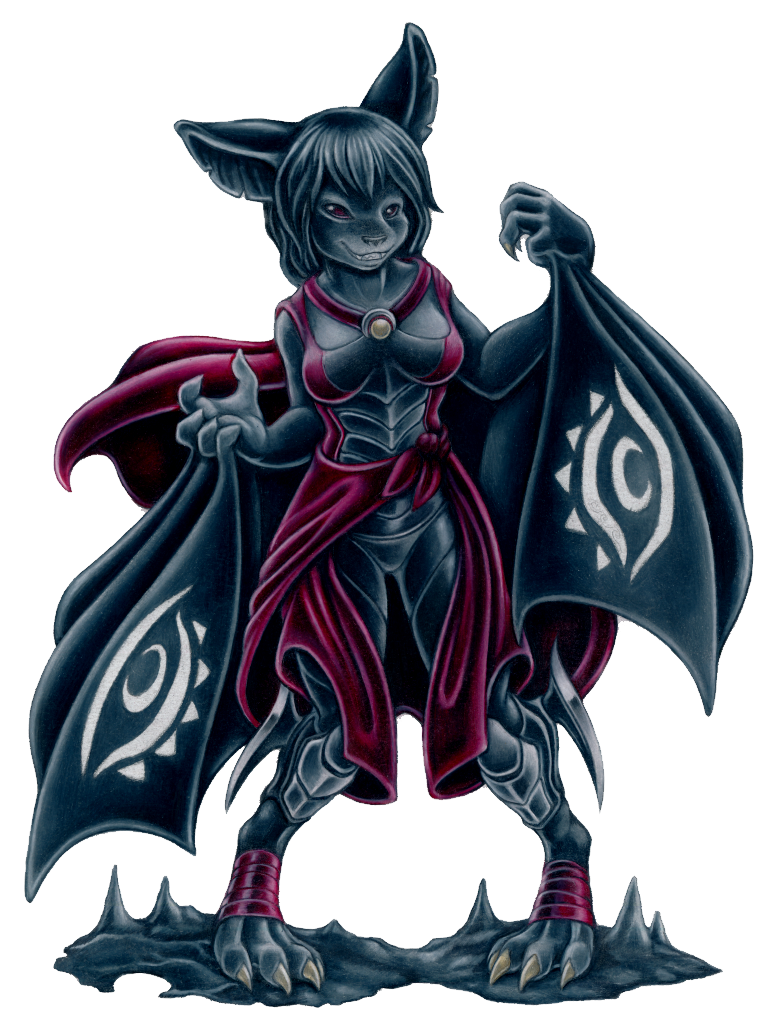 |
NIZRIL CEPN Physical Description: There are two species of cepn, one of which is incorrectly believed to be extinct. The dominant species, the N-Type (or Nizril) are descended from the mutated and uplifted vampire bats bred to exterminate the denizens of the underworld. The Creator State saw no need to send their own soldiers into the deep dark, favoring instead those who were born to it. Most of them are small, gaunt, and not particularly impressive, having only partial wing patagia and a humanoid form that’s one step closer to the kuil body than the first generation of nilkind. Most are gloss-black, though some have a mutation from the original stealth line whose fur reflected no light at all. The lighter, less violent variant, the K-Type (or Kizril) were the pilots, and rare even before the war. There was no need for a large population, as it only took a few of them to fly the exotic aircraft for which they’d been customized. They are thought to have been wiped out by the other, more aggressive half of their duon in the dark years that followed the Automatic War, though this is actually a rumor they started themselves before vanishing from the map. They may have taken a few of their ancient aerodynes with them. Society: Shaped by the experimental regimens which uplifted them, ixis display an astounding ability to work towards a common goal, whether it’s to conquer a territory or overcome much larger adversaries. Unfortunately, this same trait makes them extremely manipulable, especially in groups, and their behavior will come down to who’s leading far more than it will for most. If a set of principles no longer functions within the group, they’re more comfortable adopting another than trying to think for themselves. For this reason, it’s never easy to know how a group of them will behave. In their native country, they’ve driven out all non-ixis long ago and have little outside perspective, seeing non-ixis as gigantic monsters or titans from distant lands. Vindova’s mountain fortress contains the (now sacred) facility in which they were first created, a site they have fully occupied and will never abandon. It is the heart of their culture and only their most powerful leaders have access to the wonders within. Relations: The ixis have no love of other races, especially those whose forms were derived from their generations of suffering. They were never part of the greater world, or the Creator State, but instead relegated to secret laboratories and complexes such as the one they call their homeland. Amongst their own kind, they’re quite giving, empathic, and egalitarian, even among the two very different species. A shared animosity towards the outside world gives them unparalleled unity, though this is maintained at the cost of freedom in most regards. Relations are governed by a strict caste system, geared towards the strengthening of their nation above any individual desire. Even their license-plate names reflect this. Alignment and Religion: The ixis worship the new State, their own, in which they have no need for the outside world. They’re among the few creatures capable of hosting two different alignments – one for their own kind and one for others. This duality is a function both of their upbringing and their ancestral animosity towards the other races (especially the big ones). Adventurers: Ixis rarely adventure, being homebodies and largely regimented towards vast collective projects. Those who do generally prefer to do so in bands of their own kind, and only within their own homeland. Now and then, however, one might find an exile with a much more open view of others, especially those who disrupt the breathtakingly-racist stereotypes they learn back home.
Male Names: 112VEB, 242JON, 728MAT
Female Names: 349AHI, 113ZAT, 867LEE
|
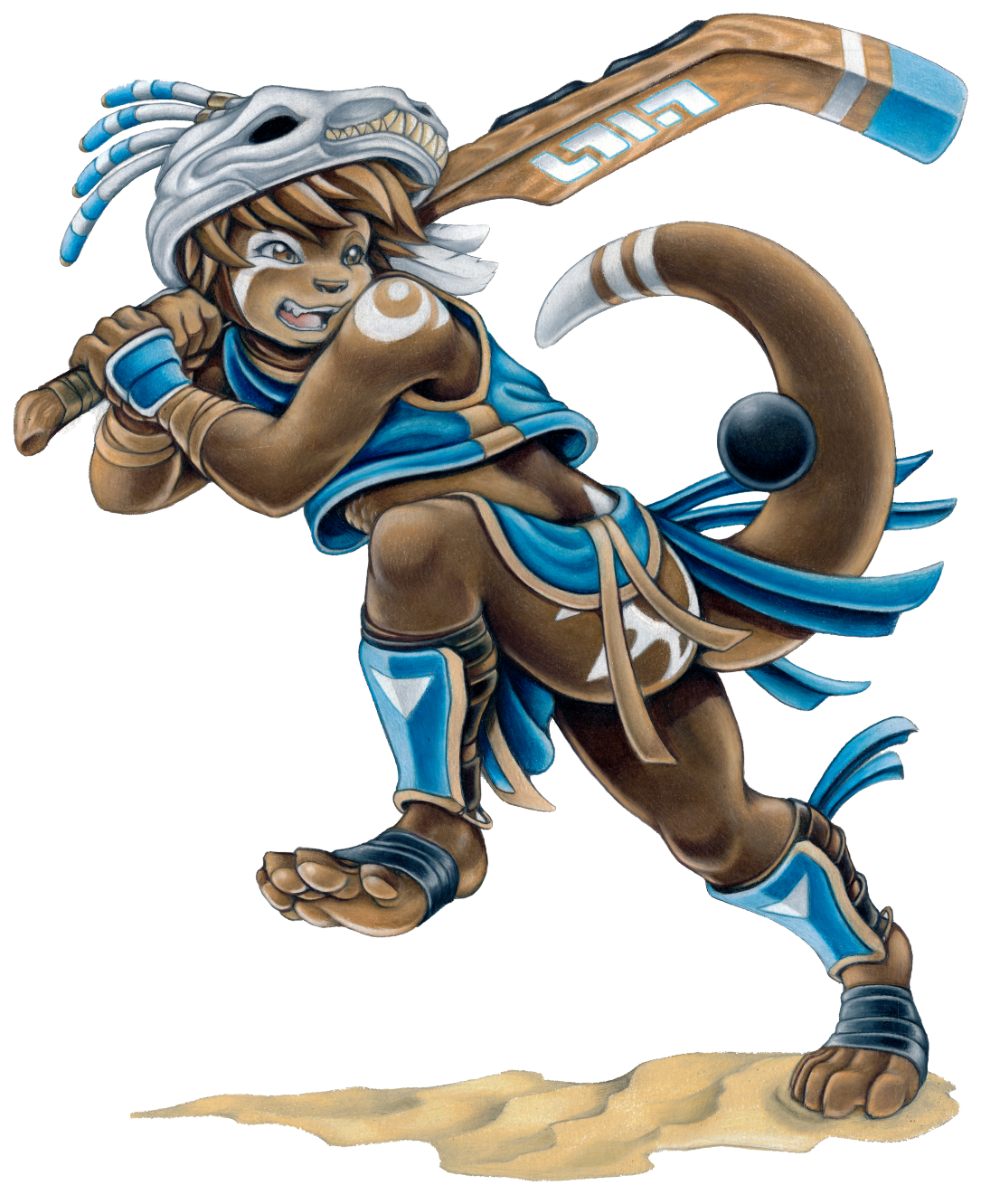 |
SOUTHERN LUTRAI Physical Description: As with most of the nilkind, the lutrai are divided into two broad categories, these being mariner and littoral. The former primarily inhabit coastal or island regions and prefer wider expanses of water, while the latter favor rivers, lakes, and fens. Derived from an otter-like ancestor, these sleek humanoids are natural swimmers and formed a significant component of the Creator State’s navy during the Second Age. They’re slightly smaller than their kuil creators, and closer to them in body shape than earlier generations of nilkind such as the skoles. One other distinction is their ‘mop’, or hair, which sets them apart from the rest of nilkind. Both species are adapted to the water though they're perfectly comfortable on land as well, with only minor physical variations. Littoral lutrai are somewhat larger and tougher than their oceanic cousins, though don't have the same kind of swimming or diving range. Society: Lutrai society is simple and easygoing. They’re able to derive enormous satisfaction from the simplest things, a byproduct of the scientific tampering which vastly enlarged their pleasure-centers and, by extension, the ease with which they’re delighted. Most of them have an incredible lust for life and will try incessantly to get others into the same ‘vibe’, but have little ambition for advancement. Lutrai have a loose tribal structure in which a group of families forms a clan, which in turn form tribes, which claim the individual islands of the Cekan archipelago, or the lakes of central Arthandur. They prize freedom above any achievement, power, or wealth, and go to great lengths to keep it. Their simple dwellings, boats, and belongings are simple to craft and replace, making it easy for them to move around or recover from disaster. Relations: The kuil bred the lutrai to be friendly and cooperative, a trait which permeates their society even after seven hundred years of independence. They try to get along with everyone, often naively, and derive great satisfaction in the process of making friends. This makes them easy to get along with, but also easy to deceive and take advantage of. They’re naturally motivated to give everyone the benefit of the doubt, and don’t cling to grudges or loss, adapting easily to new cultures without abandoning their own. Alignment and Religion: Lutrai are sun-worshippers, perhaps as a result of their progenitor or their instinctive habit of drawing suns on everything, including themselves. They recognize the sun as the ground-level of the food chain, but also as a goddess, Kij, an Demigod who embodied the sun in such a way as to make it a bit more relatable. Adventurers: Unlike most sensible people, lutrai love adventure. They just can’t wait to grow up and go running off to see the outside world, a notion their elders discourage in all but the most troublesome. It’s mostly the camaraderie they’re after, as opposed to mounds of gold or the head of some great beast. They make loyal if somewhat over-enthusiastic adventuring companions and must often by tempered by wiser companions. They tend to be more merciful towards their enemies, however, and even villainous lutrai are reluctant to kill.
Male Names: Kuwai, Paku, Wau, Thahk
Female Names: Marteke, Suma, Nylani, Sharu
|
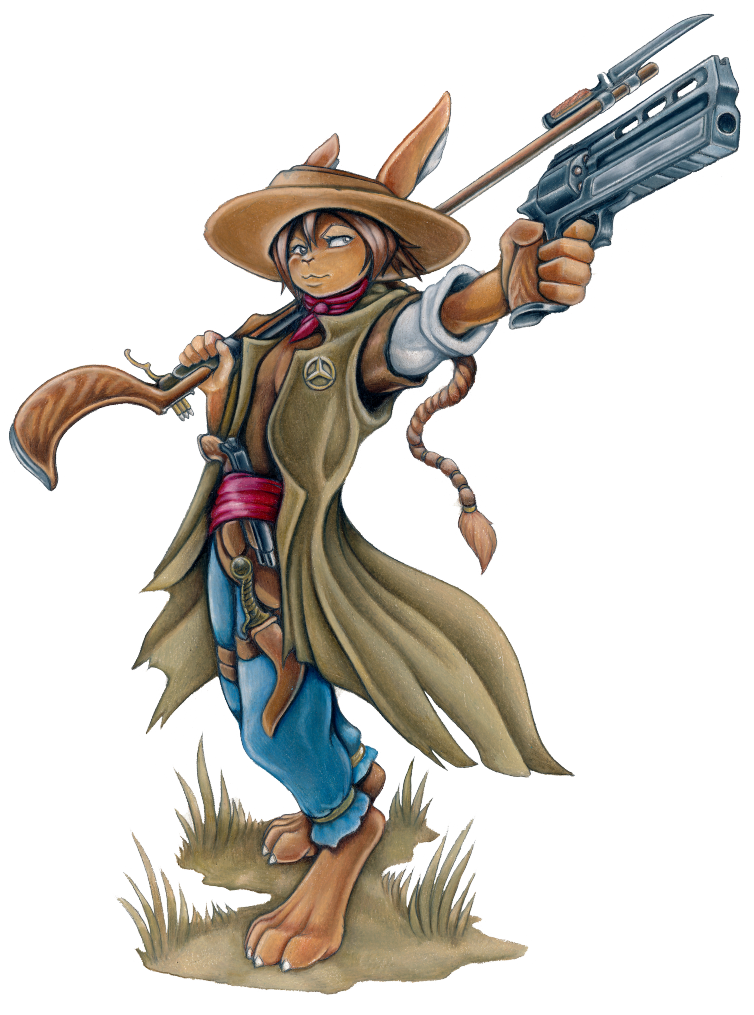 |
BASE NIL Nil were the prototype testing model of all second-generation ‘nilkind’, hence their name. Unlike the ixis, they were full-sized, slightly smaller than the kuil, but comparable enough to share the same environment without adaptation. The humanoid rabbits came in a much wider range of shape and color than the more refined third generation, though they were consistently less formidable than the kuil who made them. This was by design. Most are white until they enter a new environment outside their unnaturally-pastel warrens. Nil always have a slightly anxious look to them, as if the trait had been stamped into their entire genus. They’re very light and agile, with the rare trait of thinking more clearly when they’re afraid. They are natural sprinters and jumpers, and watching the flow of their effortless parkour can be almost unsettling. They are easily overlooked when they crouch or stand very still, and it’s virtually impossible to take one by surprise due to their profound natural alertness. Society: Nil exist in two worlds – their warren, and everywhere else. Within the warren they always know their place and socialize easily, where outside there are a thousand enemies both known and unknown. That anxious look they carry only goes away in the warren, a sanctuary of both the body and the mind. Once obedient test subjects of the Creator State, they only venture out of the familiar warren in times of wider need or personal desperation. They are always out in the world for a reason, and they’re almost always counting the days until they can go home. Those who leave their close-knit society will generally do so in small parties, allowing them to keep watch over each other and form little moments of home when they’re far from it. It isn’t so much that they dislike the outside world, they just know it’s full of mentionable dangers. This has lead some to think of them as fearful and weak, at least until they’re shot through the dome on approach. Relations: Nil are relatively calm and passive in their preferred setting: home. Here they’re cheerful and hospitable, even with non-nil they’ve come to trust. They have very strong family bonds and a cooperative nature that thrives on the idea that if they don’t work together, they’ll be destroyed by any one of a thousand different dangers. They have words for all those dangers, and procedures for avoiding or dealing with them. They refer to these rules often when outside their warren, ears on a swivel, eyes wide. They go out of their way to attract as little attention as possible, especially when in need or when injured. With few exceptions, nil will come to each others’ aid in the wider world whenever possible. Most warrens have a fairly conservative societal structure still bound by the notion of the Creator State’s Ideal Family, which they have tried to emulate. So far, it’s worked out pretty well, though it leaves them a bit unnerved (or fascinated) by the wild deviations seen in the outside world. Alignment and Religion: Though law-abiding, nil warrens impart a softened strictness that makes exceptions in consideration of circumstance. Warrens always have a council-based decision-making process, though the constituents of this council tend to vary from one to the next. They’re good natured in groups, for the most part, as they’re used to banding together in order to protect and warn each other. This might be an evolution of their conditioning or just the natural behavior of the rabbit stock that went into their making. They still think of Aethos as their father. Adventurers: Nil may be tasked by the warren’s council to venture into the world in order to get something, or rescue someone, or even just to trade some stuff. Whatever the reason, they are mostly encountered in all-nil parties with a very specific goal that they can’t tell you about (probably) because that would be dangerous and someone might hear about it. And of course, every now and then, you’ll get a young nil who actually wants to venture out into the world just to see its wonders. Male Names: Anor-32, Dolo-44, Basa-67 (of Warren X) Female Names: Juinper-42, Rose-20, Hyssop-66 (of Warren X)
Gear Shown: Extremely large gun.
|
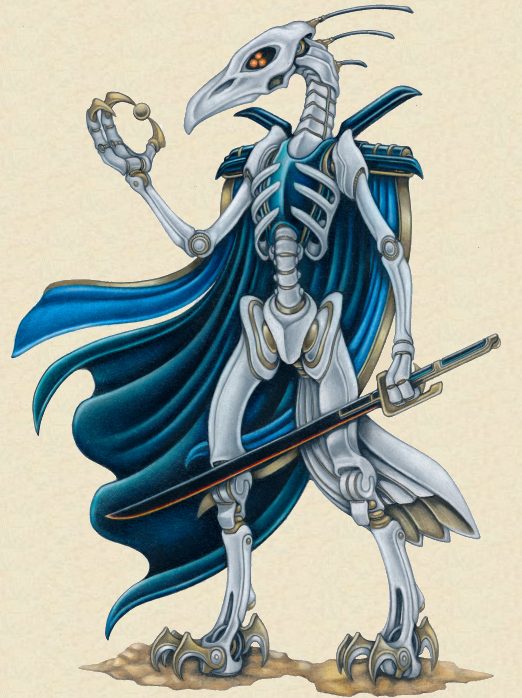 |
N-MACHINE Physical Description: Independent Machines vary wildly in their design, as they were custom-made for the individual inhabitant and their respective tastes. Such tailored bodies were typically bipedal, Medium-sized, and composed of the same age-retardant substance as so many of Aethos creations. The one thing they all share in common is that they look less like living beings, and more like walking sculptures. This type of Machine is made from luxite metals and ceramics, and is easily mistaken for a robot, golem, or other construct. In truth, it has more in common with the undead, and the white coloration of most such Machines is funerary in nature. They’ll often have glowing eyes and strange voices. Society: Machines have only the remnant of a past society, with most now relegated to hermitage at the fringes of the new age. They’re unwelcome in most communities, who see them as a dark reminder of the kuil dynasty and the Automatic War. Most such Machines remain in the wasteland of Axis, dwelling among the ruins and subsisting on readily-available components to maintain their ancient bodies. They remember little of the second age now, however, save for the fragments in which they exist, like ghosts haunting houses. Some are still in denial of their civilization’s end. Relations: Though they have little in common with the inhabitants of the new age, Machines will still form relationships with more open-minded individuals or communities in order to acquire materials or information. They have lost virtually all of their emotional capacity over the centuries and while not purely cold and logical beings, they usually come off as such. Their goal was to be more like Aethos, to be perfected, and while it didn’t go quite as promised, some still crave the vestigial trappings of their former mortality. Though prefixed with ‘he’ or ‘she’, these devotees of Aethos are androgenous – a condition of their transference to immortality. They have little use for such artifacts, or so they thought, anyway. Alignment and Religion: Independent Machines gravitate to neutral alignments, though enough of the original persona may remain to provoke variations. They are irreligious by nature, though Aethos could be thought of as their deity and few who meet them have any distinction between the two types. They are all assumed to be puppets or extensions of the false god. Adventurers: Machines do not adventure, they perform important tasks. Centuries of non-biology have eliminated the thrill of such things, and if there’s adventure to be had, it wasn’t the intent. Of course that won’t stop them from getting drawn into something new against their will, and there have been instances in which danger and daring have re-awakened long-dead passions or shattered centuries of ennui, or re-learn the value of companionship in heroic moments.
Male Names: PAX-99, LET-33, MED-67 (+ Color Suffix)
Female Names: VAX-42, ARA-20, TAW-66 (+ Color Suffix)
|